


 Help Center
 How to get help
How to integrate AI into your responses to customer messages?

 Partoo
Written by Partoo
Table of contents
By automating tasks such as replying to messages, AI helps you work more efficiently, personalise your conversations and improve the overall experience. Discover the different ways to bring AI into your responses to customer messages!
Why use conversational AI to respond to customer messages?

The key figure
According to Zendesk, 89% of consumers prioritise fast responses when choosing a business.
According to Zendesk, 89% of consumers prioritise fast responses when choosing a business.
Response speed is therefore a decisive factor when consumers choose a business. Among the other benefits of switching to AI to handle your requests, you’ll find:
With AI assistants, you can respond to customer questions and requests in real time, whatever the hour. This round-the-clock availability significantly cuts waiting times, improves customer satisfaction and strengthens trust in your brand. What’s more, AI can handle a large volume of simultaneous requests, which is particularly useful during busy periods.
Generative AI offers a unique opportunity to respond to customers in a relevant way, adapting to each of their needs. Thanks to its machine learning capabilities, AI can analyse a huge amount of data to understand customer queries, identify their preferences and provide precise, targeted responses.
When integrated into customer service, artificial intelligence becomes a powerful lever for creating sales opportunities. By offering instant, personalised interactions, it creates a smooth, effective customer experience that helps build trust and encourages prospects to take action. What’s more, some AI tools are specially designed to help you collect data and centralise your new leads directly in your CRM, making them excellent acquisition levers!
All the benefits mentioned above converge towards the same goal: increasing your sales or booking requests. Using generative artificial intelligence is therefore an excellent way to grow your business while boosting your teams’ productivity!
Maximise sales with conversational AI
Discover how to make the most of conversational AI to improve your conversational commerce strategy and drive sales growth!
How can businesses use artificial intelligence to respond to customers?
There are several ways to bring artificial intelligence into your message-response process, ranging from the most basic to the most advanced.
1) Use online AI tools to manually respond to customer messages
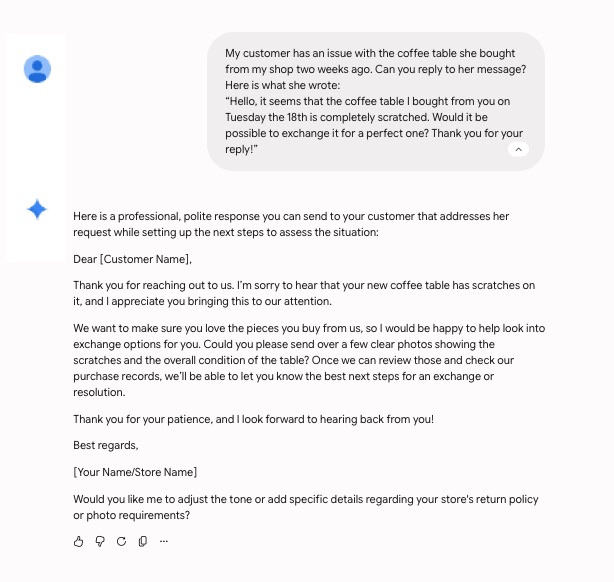
Free generative AI tools available directly online, such as ChatGPT and Gemini, can be valuable allies when responding to customer messages manually. Here are a few ways to use them effectively:
- Generate response ideas: When you’re stuck on a reply, AI can suggest different phrasings, help you find the right words and inspire you.
- Personalise responses: By giving the AI contextual information about the customer (conversation history, products purchased, etc.), you can get more personalised responses tailored to each situation.
- Improve your phrasing: AI can help you rephrase your sentences to make them clearer, more concise or more professional.
What are the limits of using online generative AI to respond to customer messages?
One of the main challenges of using generative AI to respond to customer messages is the need to manually enter each query. This can be extremely time-consuming, especially when message volumes are high. Precious time has to be spent typing, proofreading and sending AI-generated responses. What’s more, this method requires rigorous organisation to avoid mistakes (such as sending a message containing incorrect information). In short, this manual approach can quickly become a bottleneck and limit the effectiveness of using AI in customer service.
One of the main challenges of using generative AI to respond to customer messages is the need to manually enter each query. This can be extremely time-consuming, especially when message volumes are high. Precious time has to be spent typing, proofreading and sending AI-generated responses. What’s more, this method requires rigorous organisation to avoid mistakes (such as sending a message containing incorrect information). In short, this manual approach can quickly become a bottleneck and limit the effectiveness of using AI in customer service.
2) Use an AI assistant
AI assistants directly connected to your existing messaging channels offer plenty of advantages for responding to messages and optimising your customer service. On top of the benefits of online generative AI, you also get:
- Availability and speed: AI agents can respond to your customers at any time (24/7), improving their satisfaction by reducing waiting times. They can also handle a large volume of requests simultaneously, allowing them to respond to customers instantly.
- Multi-channel management: AI assistants can manage messages from different channels (Facebook, Instagram, WhatsApp, and more), centralising conversations to further simplify how customer requests are handled.
Time savings for your teams: AI agents free up valuable time for your teams, letting them focus on higher-value tasks such as solving complex problems or managing strategic customer relationships.
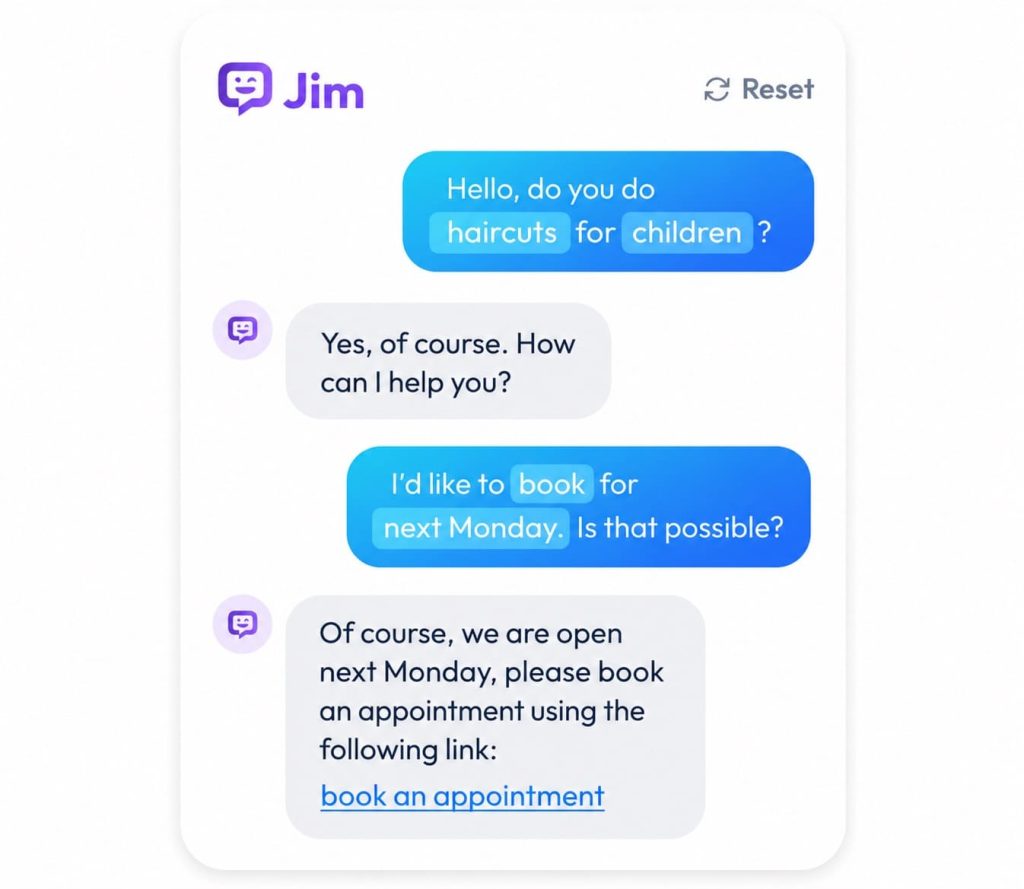
Jim, your new AI assistant
Jim automates repetitive tasks such as replying to messages and reviews, collects leads, analyses your customers’ feedback, and optimises your company’s online presence across all platforms – including in AI responses!

3) Integrate AI into your website
A potential customer looking for information about your products, services or business as a whole will probably visit your website. Webchat is therefore an excellent way to let your customers get in touch with you without leaving the page they’re browsing.

Glossary
A webchat is a general term for any form of chat accessible via the web. Most of them use simple algorithms that let the customer receive a more or less relevant response directly in the website’s chat window. Note, however, that some webchats are much more advanced, allowing users to get their answer via a different channel.
A webchat is a general term for any form of chat accessible via the web. Most of them use simple algorithms that let the customer receive a more or less relevant response directly in the website’s chat window. Note, however, that some webchats are much more advanced, allowing users to get their answer via a different channel.
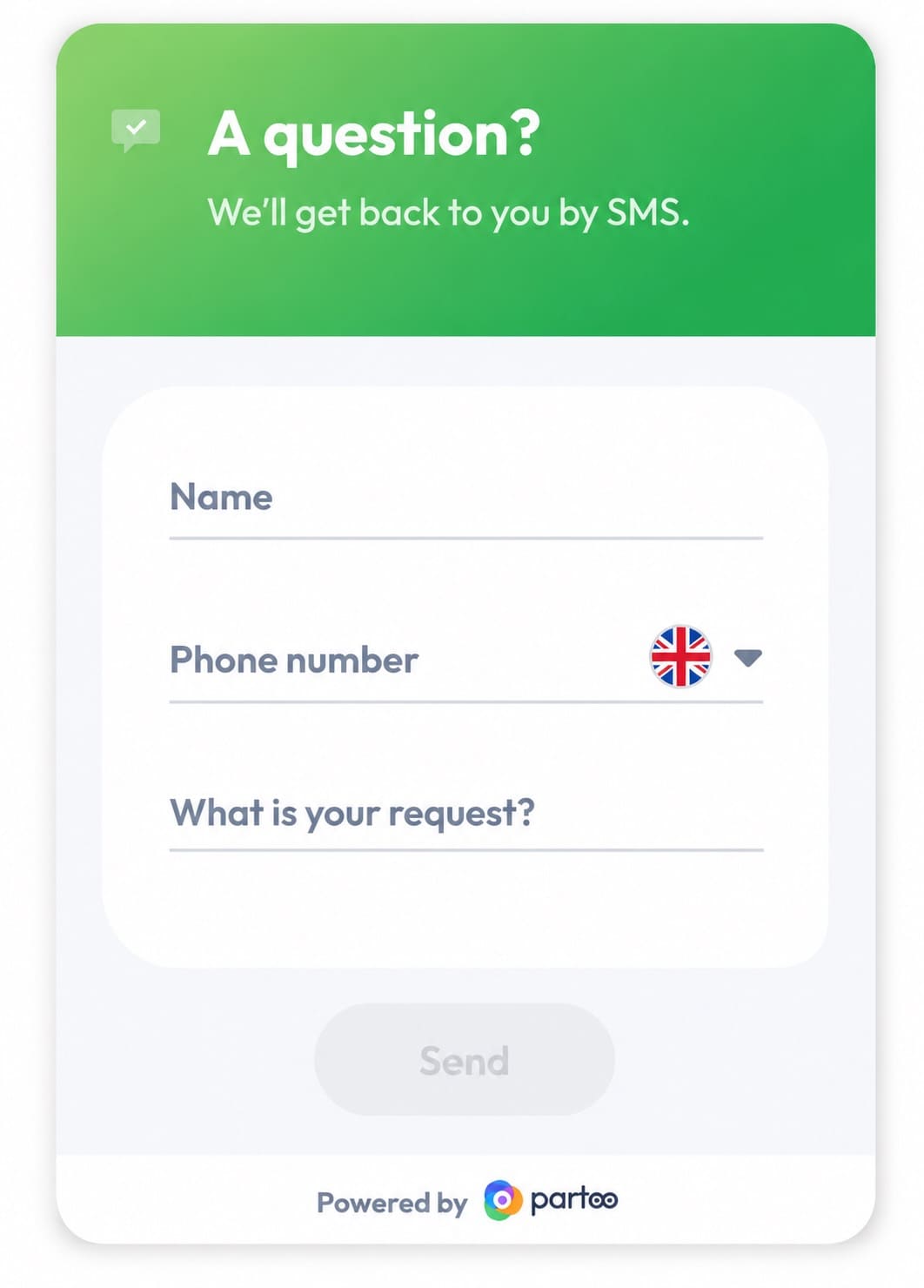
Offering an AI agent directly accessible from your website can quickly become one of your key assets. The most advanced webchat on the market, Partoo Chat, lets businesses respond to incoming questions using AI. Once again, it’s Jim, the AI agent, who handles requests received via Partoo Chat. Questions are processed meticulously and responses are sent directly by SMS to the person who asked their question on Partoo Chat.
An ultra-fast, personalised response delivered straight to consumers: everything you need to ensure the best customer experience in your industry!
By Partoo
Manage all your conversations in one click
Centralise your messaging channels and automate up to 90% of replies with AI
AI, your local marketing ally
Download our free guide and discover how AI is reshaping local search, online reputation, and conversational commerce!
Subscribe to our newsletter
Receive our best articles and practical guides directly in your inbox every month