



 Help Center
 How to get help
Which type of store locator should you choose for your business?
Table of contents
We’re in an era where conversational AI is increasingly acting like a personal shopper, meaning your localisation interface, AKA store locator, is an invaluable strategic tool. It provides a link between your online presence and in-store traffic, so integrating one into your website is now a must if you want to drive online users to your physical stores.
But given the range of store locators available, which one should you choose to optimise your web-to-store strategy? Find out more in this article.
The “showcase” store locator for small businesses
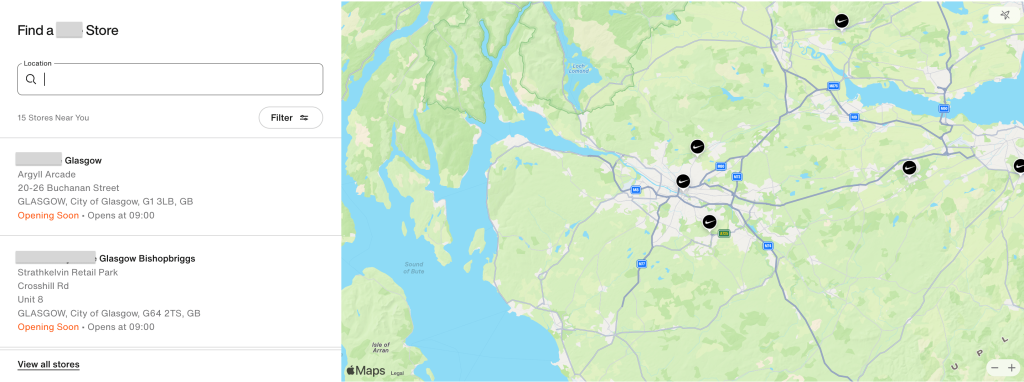
A “showcase” store locator usually has a single page with an interactive map that lists all outlets. Users can click on pointers on the map to view a branch’s basic information, such as the address, phone number, and opening hours.
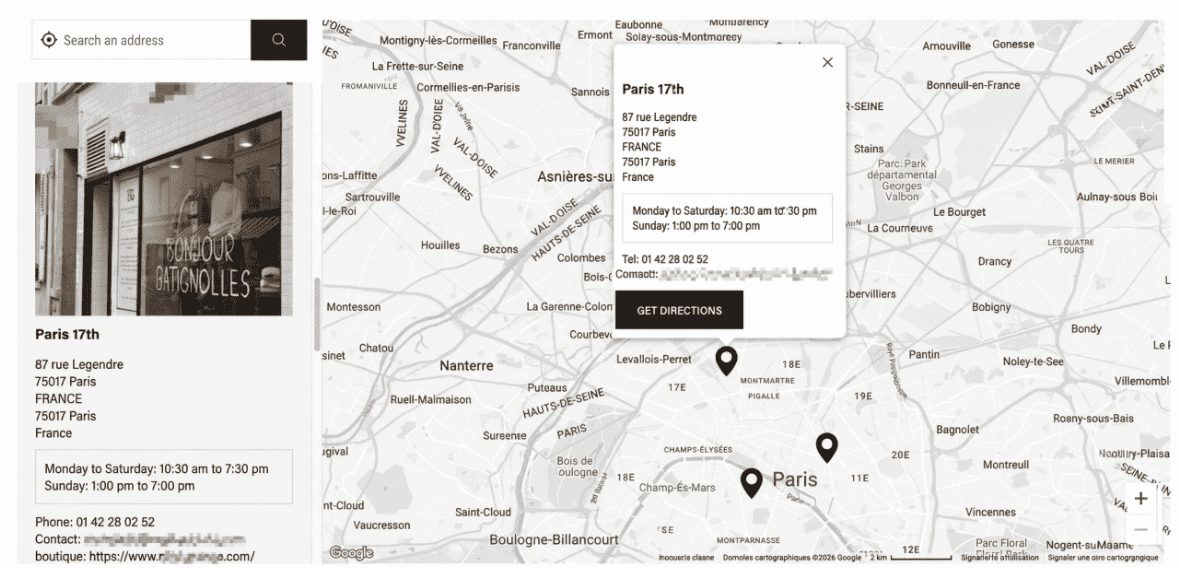
This version is perfect for small businesses, artisans, or networks that have fewer than ten branches.
However, although this type of store locator is easy and cheap to set up, the lack of pages dedicated to each outlet can affect its impact. This means the benefit of having a unique URL for each outlet can lower its ranking across traditional and GenAI search engines (GEO).
The “optimised store locator” for companies that want maximum visibility
This type of store locator is the standard for any brand wishing to stand out on local searches.
It uses a clear and well-structured format:
- A home page (Index): with an interactive map such as Google Maps, Apple Maps, or Open Street that displays all outlets.
- Hub pages: intermediate pages that group outlets according to the geographical area or by service to appear in broad searches.
- Dedicated local pages: with a unique page for each outlet that acts as a “digital identity card” for search engines.
This type of store locator is ideal for chain stores or big nationwide brands. Thanks to its structure and powerful internal linking, each page can be optimised to appear in local searches.
By having an optimised store locator, your company will increase its chances of appearing in specific local searches such as “vegan bakery in east Reading” or “garage near Wooten Bassett”.
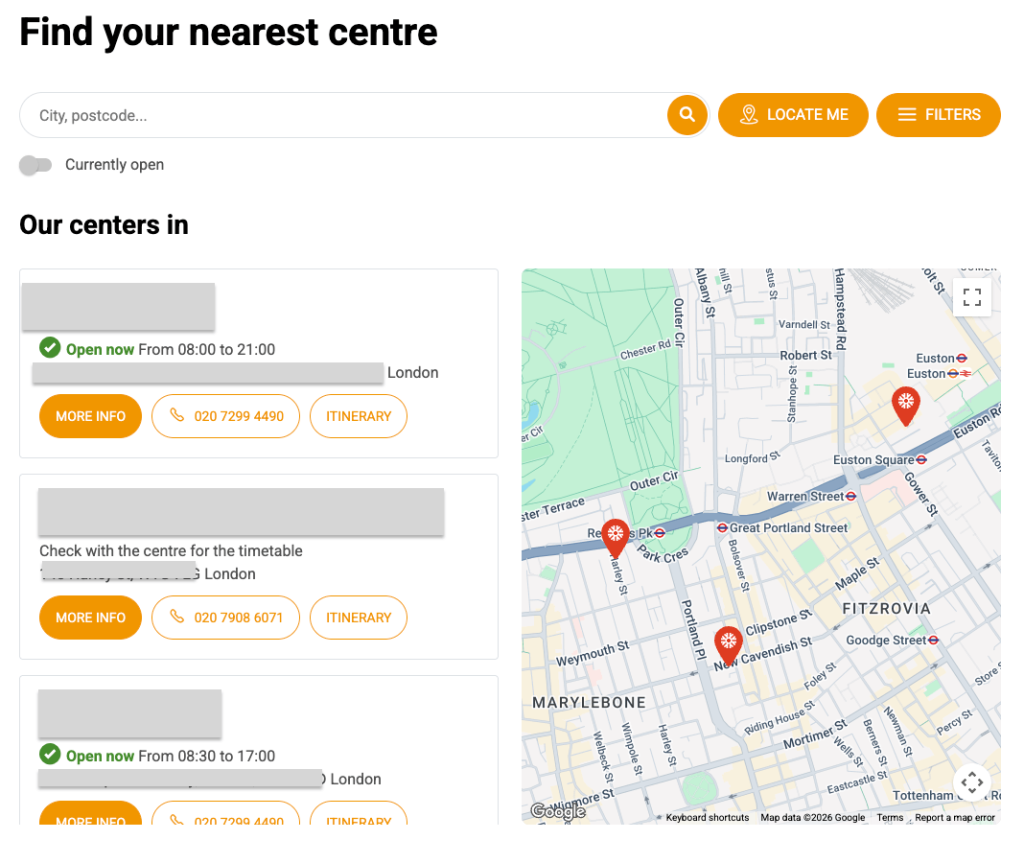
Creating an optimised store locator means you can develop entry points on the web and improve your local search ranking while enhancing your local SEO and GEO.
Indeed, for AIs to recommend an establishment, they require verifiable information; an optimised store locator guarantees reliability for algorithms.
Partoo helps you roll out an effective Store Locator!
- Increase traffic and visits to your business
- Centralise all your business data
- Improve your visibility on both traditional and AI-powered search engines

The product locator to display product availability in real time
In an intensely competitive market, accessibility and proximity are now essential requirements for businesses. The product locator takes things a step further than classic store locators. Here, the user can find an outlet plus check product availability within a set geographical area.
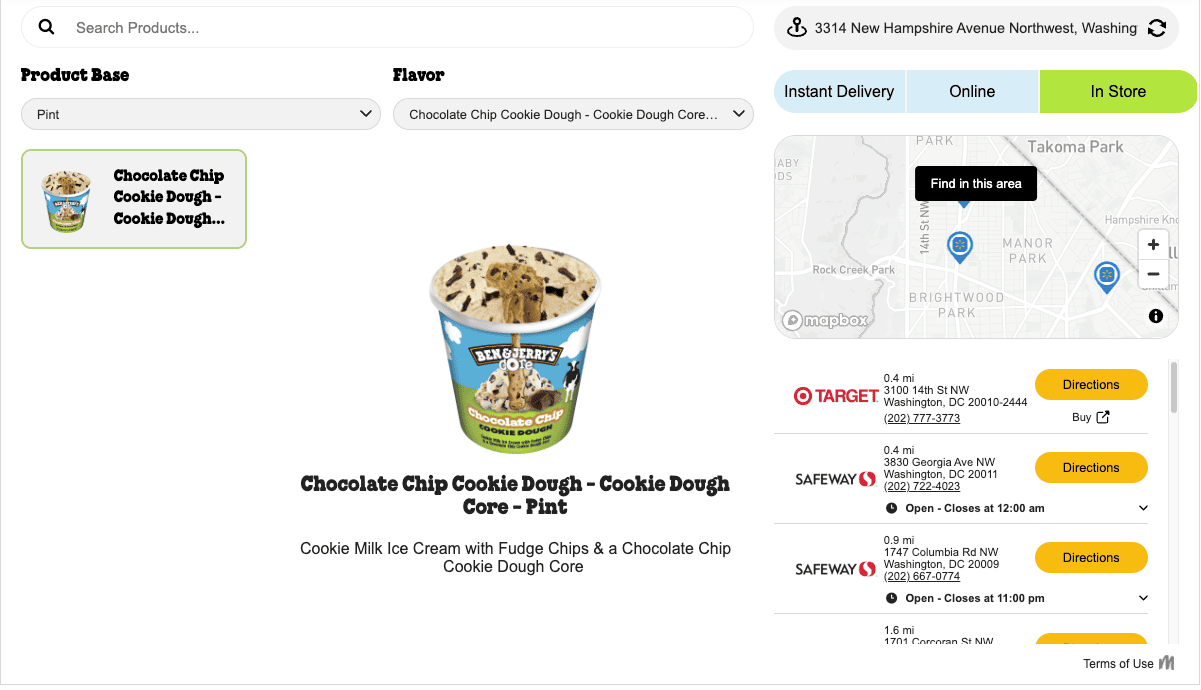
For example, if a user searches for a pair of padel shoes in a specific colour and size near their home, a product locator can instantly confirm if they’re in stock at the nearest branch, turning a simple search intent into an immediate visit.
Note that nowadays, e-shops often display in-store stock availability, with a corresponding link to the store locator’s local page. If the product is unavailable at the nearest outlet, the product locator may display its availability in retailers’ nearby stores.
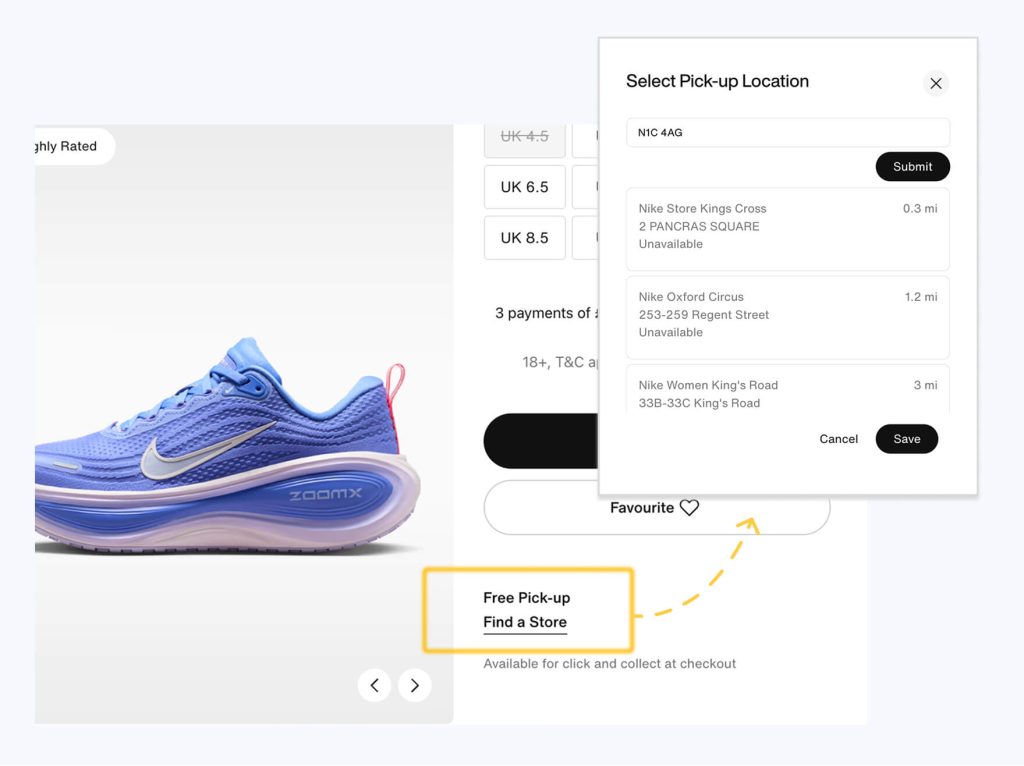
The product locator is a more-than-useful source of information for customers and will give the competition a run for their money. On the other hand, this tool needs to be connected to a warehouse’s inventory management software in real time, which involves significant set up costs.
At a time when smartphones dictate purchasing journeys, retailers must meet mobile users’ need for immediacy. Imagine a customer searching for product while they’re out and about. Thanks to the product locator, they can instantly check if the item’s available in your nearest store.
This tool’s straightforward answer to “Where can I buy this product right now?” reduces customer frustration, naturally boosts Click & Collect, and turns a simple mobile search into a high-value-added service.
The dealership locator for distributed brands
The dealership locator is a type of store locator that allows customers to find where to buy a brand’s products at a partner reseller. A must for businesses that don’t have their own stores, this tool meets consumers’ accessibility expectations by guiding them to the nearest authorised reseller.
To give you an idea of how it helps, imagine you want to buy a beauty product from a brand that doesn’t have physical stores. Thanks to the dealer locator integrated on its official website, you can immediately find nearby retailers that sell the brand’s products. So a dealer locator is way more than a mere localisation tool; it increases sales and boosts customer satisfaction rates.
The service locator to geolocate a service rather than a physical store or branch
While the afore-mentioned store locators focus on products or physical outlets, the service locator meets an immediate practical need: find infrastructure, equipment, or a technical access point. Here, the user doesn’t want to speak to an advisor or buy an off-the-shelf item but rather access a service or drop-off/pick-up point.
This type of locator is essential for public or private service networks offering services that are immediate and close by such as an EV charging station, a cashpoint, and parcel pick-up point, or specific waste disposal site.
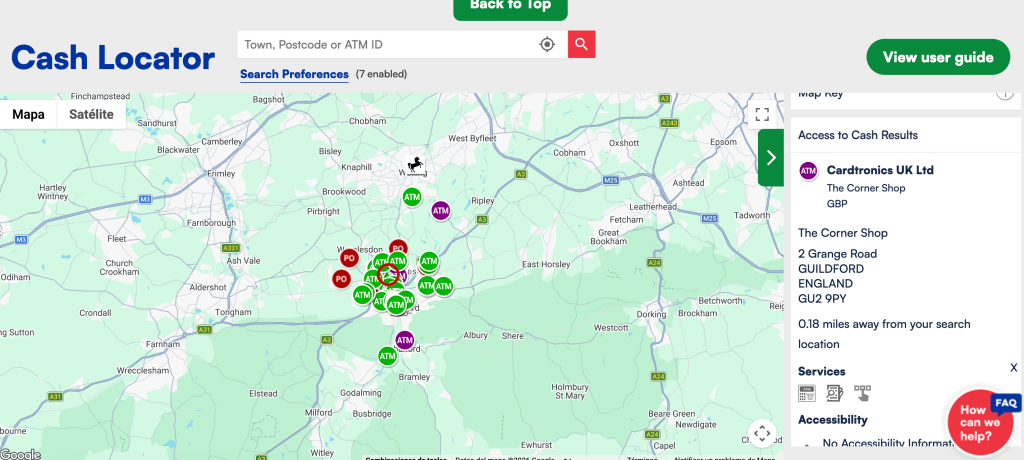
Table illustrating the different types of store locator
Here’s a comparison of different store locator types to help you choose the one that meets your needs and budget:
| Features | Showcase store locator | Optimised store locator | Product locator | Dealership locator | Service locator |
| Definition | Single page with map and list | Hierarchical structure with individual local pages | Search based on stock availability | Locates third-party resellers (partners) | Locates an automated or terminal |
| Target | Small businesses, Artisans, Networks < 10 outlets | Nationwide brands, franchise networks | Retailers, e-tailers with physical stores | Distributed brands without their own network | Companies managing equipment or supply point networks |
| Benefits | Low cost, quick set-up | Powerful internal linking, maximum visibility on local queries | Boosts Click & Collect | Guides buyers to authorised resellers, supports partners | Meets an immediate practical need |
| Drawbacks | No dedicated local pages (limited SEO and GEO) | Requires more unique page-specific content | Requires real-time inventory synchronisation | Less control over the final customer experience | Requires up-to-date technical data (availability) |
| Impact on SEO/GEO | Low: as there is only one URL | Excellent: appears in proximity queries and easily readable by AI | High: meets immediate purchase intentions | Medium: strengthens the brand’s authority over its third-party network | High: Captures emergency or convenience searches (e.g., “near me”) |
Whatever option you choose, integrating a store locator is now an essential step for any company with a physical network.
It’s not only useful for customers, but also a powerful ranking booster. It catches “nearby” search intents AND provides search engines and AI with reliable and structured data about your physical outlets.
With a store locator, you’ll improve the web-to-store journey, automatically increase in-store traffic, boost your conversion rate, and strengthen your brand’s credibility wherever you are based!

By Partoo
The local customer experience platform built for your network
Transform the customer experience across your businesses with AI
Stay one step ahead!
Download the 2026 Barometer on online presence and e-reputation of businesses and gain practical insights to increase your chances of being cited by AI.
Subscribe to our newsletter
Receive our best articles and practical guides directly in your inbox every month