



 Help Center
 How to get help
Which solution should you choose to create your store locator?
Table of contents
Did you know that roughly 20% of website visits come from a store locator? A core web-to-store strategy, a store locator bridges the gap between the digital and in-person experience, turning an online user into a physical customer.
Store locators face the challenge of converting customers using search engines, so must be well-thought-out. So should you build one in-house or outsource to a service provider? Find out all you need to know in this article.
Option 1: Develop your store locator in-house
If you create a store locator in-house, you’ll need the right technical resources (devs, designers, SEO specialists) to build the tool from scratch. Companies that want full control over their ecosystem often go down this road.
While this option has its advantages, it still has several drawbacks:
| Benefits | Drawbacks |
|---|---|
| – Zero external costs: no need to fork out for a service provider as the tool will be built and managed in-house. – Fully customised: you get to choose the format and features. – Branding: the tool will be natively aligned with your website’s visual identity and overall UX. – Control over data: you manage all outlet-related data. – Internal responsiveness: need tweaks? Your in-house team will handle everything. | – Significant workload: an intensive in-house endeavour that may overburden your technical roadmap. – Longer set-up times: in-house is often slower than with a specialist service provider. – Technical complexity: difficulty managing third-party APIs (such as Google Maps) and server maintenance. – Ongoing maintenance: need to dedicate resources to fix bugs and keep the tech side updated. |
You’ll also need to make sure that your servers are robust enough, as an out-of-service store locator will negatively affect in-store traffic.
Option 2: Use a specialist external service provider to develop your store locator
The other option is to outsource the development of your store locator. This means you’ll benefit from approved technology and adequate support. Nowadays, numerous agencies offer store locators with different features and at different rates.
Here’s a closer look at the pros and cons of outsourcing:
| Benefits | Drawbacks |
| – Advanced SEO expertise: with optimised pages (dynamic URLs, structured data, internal linking). – Speedy set-up: Can usually be rolled out within 1 to 3 months. – UX optimised to convert customers: advanced features included (autofill, filters by services, Click & Collect, etc.). – Dedicated support: a project manager on hand to coordinate the deployment and support your in-house teams. – Maintenance & after-sales: servers that can handle the workload and security updates included, freeing up your in-house teams. | – Requires investment: rollout and any necessary maintenance can be costly. – Dependency on the service provider: requires building a trustworthy relationship with the partner. – Defining the project: requires effort to define your precise needs throughout the process. – Limited technical autonomy: you have to depend on your service provider’s update roadmap. |
Locator Plus: Google’s store locator
Google is also an external service provider that has its own store locator tool. Locator Plus is free and lets you integrate a store locator on your website to make finding your outlets easier.
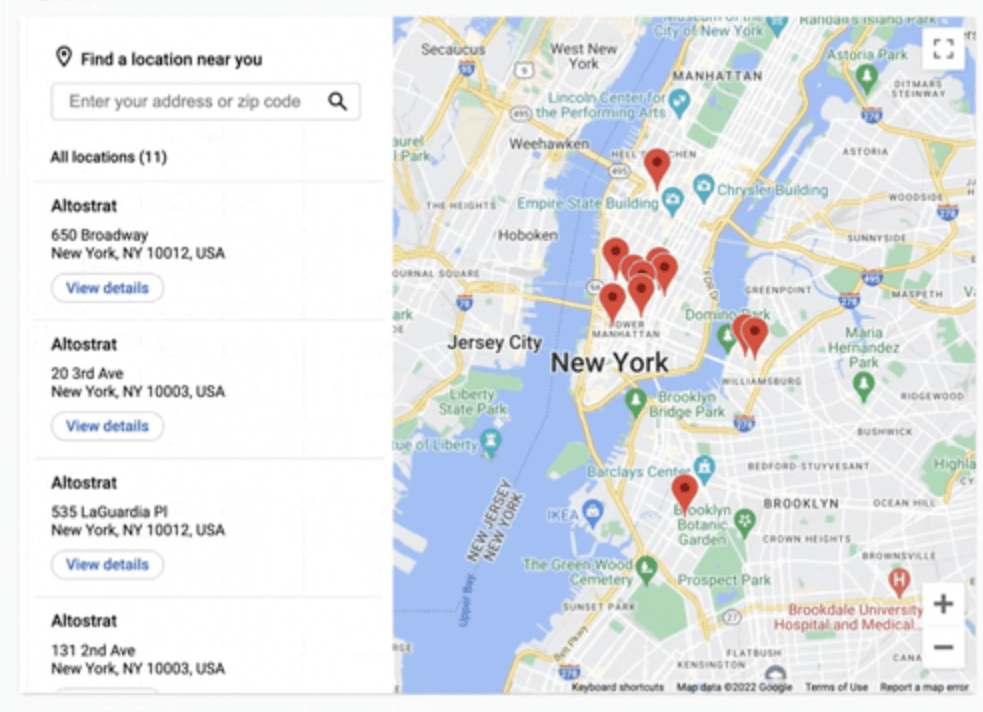
While this free tool seems a good choice for quickly adding a map, it won’t meet the needs of a large brand:
- A tricky rollout: this tool isn’t a turnkey solution. Installing it is time-consuming, technical, and requires manual code integration, which can be a hindrance for some companies.
- Poor SEO optimisation: This is the tool’s number one drawback. It does not have the local pages needed for effective SEO, the URLs aren’t optimised, and internal linking is non-existent.
- You can’t customise the interface: the tool won’t let you apply your company’s visual identity.
- Limited user experience: Features are minimalist (one map, one list, and one search bar), with no advanced filtering or seamless UX options.
Locator Plus is, therefore, a functional yet rudimentary troubleshooting solution. You can display outlets to users browsing your website, but you can’t use it as an acquisition lever to attract new customers via local searches.
Option 3: Create a high-performance store locator with Partoo
Partoo is the specialist go-to strategic partner to help you create a perfectly optimised store locator. Our experts (project managers, designers, and devs) work together to create tools designed to convert.
By choosing Partoo to take care of your Store Locator, you’ll benefit from:
- SEO and GEO optimisation: Unlike traditional solutions, Partoo’s store locator is structured to feed conversational AI. By providing ultra-qualified data, your outlets will be deemed “trusted entities” and, therefore, cited when AI responds to online queries.
- Visual Identity & Premium UX: We reproduce your website’s visual identity so your store locator perfectly matches your brand image. Our Store Locators are designed for a mobile-first experience with a seamless interactive map that guides the search engine user to one of your outlets.
- Project management and responsive support: A dedicated team by your side from the design stages to deployment. In addition, our customer support will be there for any post-launch changes.
- Unified data and real-time updates: Automate the management of your online presence by centralising your Google listings and your Store Locator with Presence Management and your customer reviews with Review Management via a single dashboard. Whether it’s changing your opening hours in a single click or managing your Google, Facebook and TripAdvisor reviews, you’ll get effortless, instant, and synced updates for consistent branding.

Some of our clients’ key figures
- +28% traffic on the Store Locator in 5 months and +41% after 1 year at SUP INTERIM
- At Unilabs, 12 Store Locators were rolled out in just 3 months, with more than 13,000 sessions recorded in the first month
- 10,000 sessions per day on average with more than 235 local pages for La Foir’Fouille.
- +28% traffic on the Store Locator in 5 months and +41% after 1 year at SUP INTERIM
- At Unilabs, 12 Store Locators were rolled out in just 3 months, with more than 13,000 sessions recorded in the first month
- 10,000 sessions per day on average with more than 235 local pages for La Foir’Fouille.
Domino’s, Swisscom, Terranova, Unilabs, etc. Numerous companies have chosen us as their trusted store locator partner. So why not join them? Feel free to contact us for more info.

By Partoo
The local customer experience platform built for your network
Transform the customer experience across your businesses with AI
Stay one step ahead!
Download the 2026 Barometer on online presence and e-reputation of businesses and gain practical insights to increase your chances of being cited by AI.
Subscribe to our newsletter
Receive our best articles and practical guides directly in your inbox every month