



 Help Center
 How to get help
AI Overviews: why your Google searches will never be quite the same
 Written by Partoo
Table of contents
Rolled out across more than 200 countries, available in 40 languages, and used by over a billion people, Google’s AI Overviews have fundamentally shifted the way we search online. Powered by Gemini, Google’s AI model, AI Overviews are changing the way users search — and with it, the rules of SEO.
In this article, we cover everything you need to know about AI Overviews.
What are Google’s AI Overviews?
AI Overviews is a search feature that uses artificial intelligence to generate personalised responses directly at the top of Google search results. It synthesises information from multiple web sources to deliver a direct, comprehensive answer to a user’s query — without requiring a click through to an external site.
The technology is powered by Gemini, Google’s AI model, specifically optimised for search.
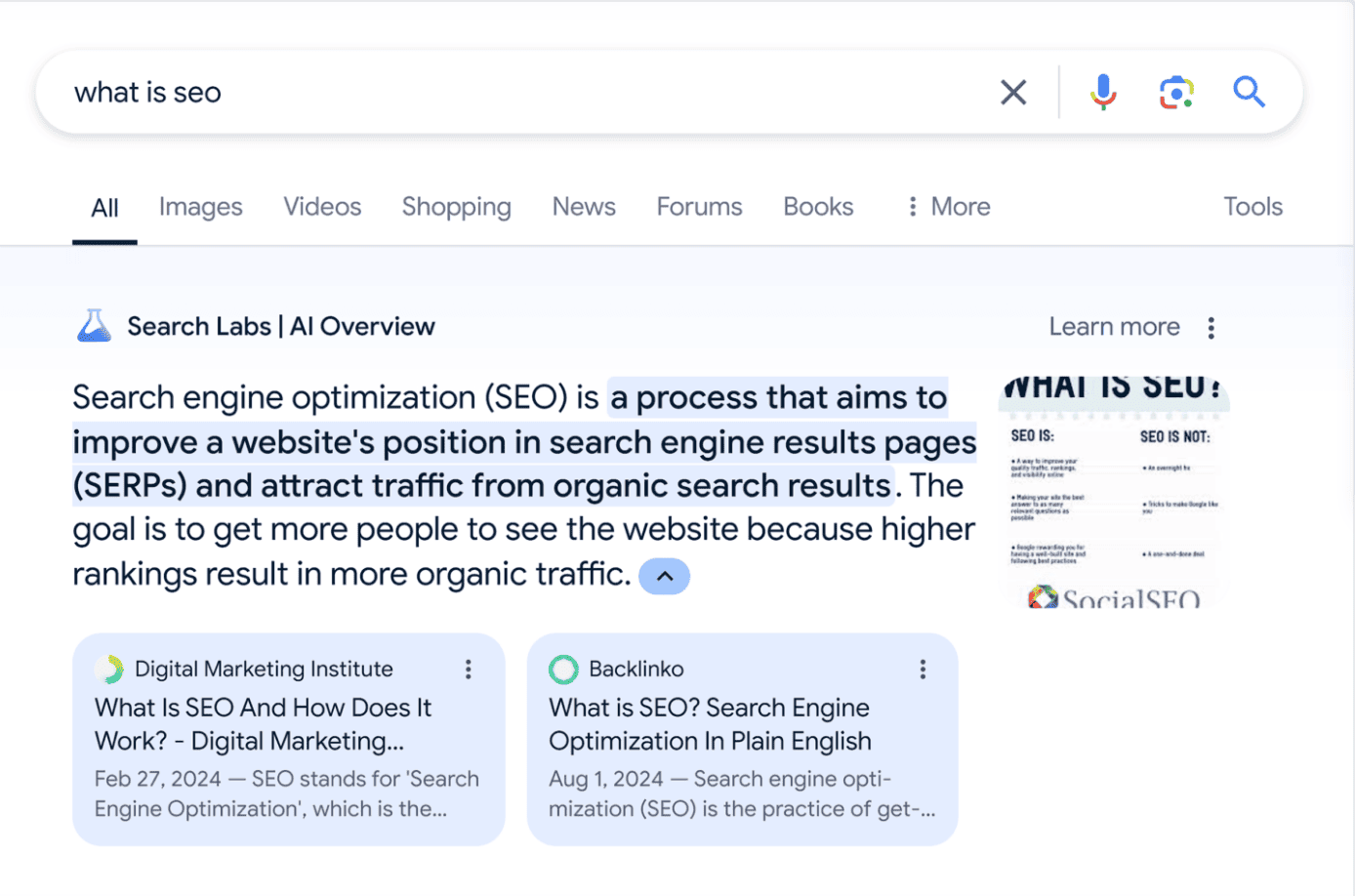
A genuine shift in the world of SEO, AI Overviews can understand the context behind complex queries and generate coherent, informative responses.
How do AI Overviews work?
It starts when a user types a query into Google’s search bar. To generate a relevant response, the AI Overviews system goes through three stages:
- Processing the data: the algorithm scans Google’s index in real time to identify the most relevant sources. This filtering stage prioritises authoritative sources (E-E-A-T*) to inform the response.
- Interpreting context: thanks to Gemini, Google no longer simply matches keywords. It analyses the semantics and search intent behind a query to get to the heart of what the user actually needs — even for complex or nuanced requests.
- Generating a summary: the AI drafts a unique response, citing the sources used as clickable links.

Worth noting: AI Overviews are multimodal — they now incorporate images and videos, and draw on structured data to enrich responses.
*E-E-A-T is Google’s trust score. It’s used to assess whether your site is a reliable source, based on four criteria: Experience, Expertise, Authoritativeness, and Trustworthiness.
What triggers AI Overviews?
Contrary to what you might expect, AI Overviews don’t appear for every search. Two factors determine whether they show up:
- The trigger criterion: AI steps in primarily for complex, comparative queries, or ones that require synthesising multiple sources. For simple searches (e.g. “weather” or “stock prices”), standard results or dedicated widgets do the job perfectly well.
- Added value: Google only displays an AI Overview if it delivers a faster or more complete answer than the top organic result. If a website already answers the question perfectly in two lines, the AI often deems a summary unnecessary.

The impact varies significantly by sector!
AI Overviews appear far more frequently in some sectors than others. They’re virtually omnipresent for health and technology topics — triggering in over 91% of cases — but much less common in sectors like automotive or e-commerce.
AI Overviews appear far more frequently in some sectors than others. They’re virtually omnipresent for health and technology topics — triggering in over 91% of cases — but much less common in sectors like automotive or e-commerce.
Now we know what triggers AI Overviews, let’s look at how to appear in them.
How to appear in AI Overviews
There’s no magic button that forces Google to feature your site in its AI summaries. That said, analysing early results reveals some clear patterns. Here are the key levers for becoming a source that Gemini favours:
1. Build semantic authority
To reduce the risk of hallucinations, Google favours sources that have demonstrated reliability. The goal is to prove your expertise — the famous E-E-A-T. To get there:
- Cite your sources by consistently adding a “References” or “Sources” section at the bottom of the page to back up your statistics and quotes.
- Build internal linking by creating content clusters that show you cover a topic in depth, not just superficially.
2. Adopt a ‘zero-click’ format
To have a chance of being cited, your content needs to be easy for the algorithm to extract. The less effort the AI needs to pull out your answer, the higher your chances of being cited.
- Clarity first: write short paragraphs and give direct definitions.
- Clear visual structure: use bullet points and comparison tables — these are the generative snippet’s favourite building blocks.
- Question-based headings: use H2 or H3 tags phrased as direct questions (e.g. “How do you calculate your debt-to-income ratio?”).
3. Prioritise long-tail and informational intent
AI Overviews are primarily triggered by complex queries where a simple list of links isn’t enough. Rather than targeting generic keywords like “motorbike insurance”, aim for answers to specific problems — think long-tail queries like “how do I cancel motorbike insurance after selling my bike?”
The more precise the question, the more the AI needs an expert source to answer it.
4. Use structured data (Schema.org)
Structured data is the universal translator between your site and AI. It lets Google categorise your information without ambiguity. Don’t hesitate to use Schema.org tags such as FAQPage, Product, HowTo, or Review.
This helps the algorithm instantly identify a product’s price, the steps in a tutorial, or the answer to a frequently asked question — making it far easier to pull into an AI summary.
What do AI Overviews mean for businesses?
AI Overviews are sending shockwaves through the SEO ecosystem. Since their rollout, the data has shown significant shifts in both search behaviour and website performance.
- A drop in informational traffic: sites ranking in top positions used to enjoy strong click-through rates. With AI Overviews, those same sites can see a significant decline (up to 34.5% according to some studies) when the AI answers the question in full.
- The local pack is fading: in the United States, the traditional local pack appears to be gradually being replaced by AI Overviews — a shift that’s expected to reach the rest of the world before long. Moving from a list of results to a single AI-generated answer is fundamentally changing how local businesses appear online.
- SEO is evolving: AI increasingly understands complex queries. The era of “buy garden décor” is giving way to searches like “I’m looking for affordable decorations for my garden — where can I go?”
By Partoo
The local customer experience platform built for your network
Transform the customer experience across your businesses with AI
Stay one step ahead!
Download the 2026 Barometer on online presence and e-reputation of businesses and gain practical insights to increase your chances of being cited by AI.
Subscribe to our newsletter
Receive our best articles and practical guides directly in your inbox every month