


 Help Center
 How to get help



September 16, 2026
Voice of Customer: the guide to listening and taking action with AI
Most businesses are already collecting Voice of the Customer data: Google reviews are piling up,…


Powered by Jim

Table of contents
In our hyper-competitive e-tail and online service world, having a strong local presence is no longer an option; it’s a must if you want your business to grow. And if you want to appear high up in Google’s results, mastering SEO search intent is a necessary skill. This key metric, which Google continually refines, helps companies target the most relevant queries for their business and drive qualified traffic to their business. Partoo explains all you need to know in this article!
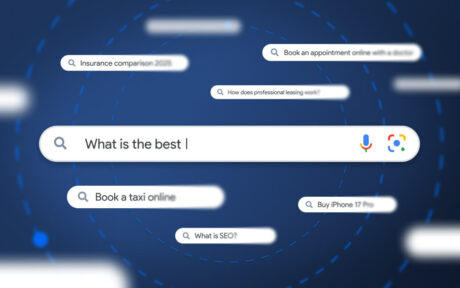
A search intent (or user intent) is the reason behind an online search. It’s why a person performs a specific search. Once upon a time, Google just indexed keywords, but nowadays, its algorithm tries to figure out the need behind every query. Google strives to give the perfect answer to every question, right from the first result.
Search intents can be grouped into 4 (or even 5) general categories that represent the stages in the customer journey. For local SEO, there is a more “detailed” underlying purpose, AKA the “local search intent”.
Good to know
So-called local queries include terms such as “near me,” “nearby,” or if they mention a specific city, neighbourhood, or street.
So-called local queries include terms such as “near me,” “nearby,” or if they mention a specific city, neighbourhood, or street.

What’s the point of each search intent type?
Since each search intent corresponds to a specific need, the proposed results must be aligned with the searcher’s expectations. Here’s how to optimise your online presence to meet each search intent type:
Did you know?
Informational intent is the most common, accounting for 80% of global online searches. However, it is sales and transactional intents (including local searches) that have the best conversion rate.
Informational intent is the most common, accounting for 80% of global online searches. However, it is sales and transactional intents (including local searches) that have the best conversion rate.
Local search intents are, by nature, queries that occur much further down the conversion tunnel. When the user searches for a “nearby out-of-hours pharmacy” or “bike shop open Sunday in Glasgow”, they are expressing a clear intent; it’s immediate, in a particular location, and they intend to do a specific thing in a specific place. So an online search leading to a physical visit becomes a crucial moment in the conversion process.
Here are some tried-and-tested methods for appearing high up in your potential customers’ local searches.
Your Google Business Profile (formerly Google My Business) is your establishment’s online digital identity card. It is the central element when positioning your business to match local search intents.
However, it needs to be carefully optimised to appear in Google search results and ensure your visibility reaches a wide audience. In addition to your basic details (outlet/establishment’s name, address, and phone number), here’s some additional information to include so your profile’s complete:
It’s also worth adding a detailed description and links to your website, socials, etc. The more complete the listing, the more likely you are to align with the different search intents.
Rank Higher on Google: Optimise Your Listing
Discover the complete guide to Google Business Profile optimisation, featuring exclusive expert advice and actionable checklists to boost your local visibility.
Customer reviews are essential for a well-optimised Google profile. Indeed, reviews are a powerful signal for two types of search intent:
Sales and/or transactional intent: customer reviews reassure users before they buy a product/visit an outlet. They can assess the benefits of your offer and build a sense of trust in your business.
Local intent (SEO): Firstly, Google uses reviews as a local ranking factor. Secondly, reviews have natural language that may include keywords you haven’t considered. For example, the phrase “best bike repair service near Notting Hill Gate tube” allows Google to associate your listing with:
These terms will broaden the semantic relevance of your listing and improve its ranking on location-specific long-tail queries. Finally, a customer review can be used for a Google “justification“, AKA a snippet detailing what your establishment offers.

Don’t neglect your Google listing’s e-reputation. Our Review Management solution lets you centralise review collection, response, and analysis for all your outlets/branches and across every platform (Google, Yelp, Facebook, etc).
Creating content specific to each location is essential for companies with numerous branches. To do this, we recommend you:
By using terms that include the region, city, or even nearby street names, you’re telling customers and Google that you’re operating in that specific area.
Having location-specific pages lets you share unique and targeted content, such as in-store news, particular services, or local events.
Partoo makes this a cinch thanks to the Store Locator, a tool that lets you list your outlets on your site through an interactive map and also create a dedicated page for each location.
Good to know
In September 2025, Google updated its link policy for Google Business Profile (GBP) listings: every establishment must have a dedicated landing page to enhance the profile’s relevance.
In September 2025, Google updated its link policy for Google Business Profile (GBP) listings: every establishment must have a dedicated landing page to enhance the profile’s relevance.
Search intents are constantly evolving The arrival of artificial intelligence is changing the way users search and how Google responds. This is why new search intent trends have emerged:
Tools like Google Lens, Circle to Search and Google Search Live mean “classic” keywords are being increasingly replaced by more natural, conversational phrases. A case in point would be “London weather” replaced by “what’s the weather in London going to be like this week?”. Internet users are looking for precise, and often immediate results such as “where to buy a coffee on my office’s street?”.
Long-tail searches are more than just specific; they mean customers are further down the purchase journey. For example: “M&S children’s jumper” is less likely to convert a customer than “M&S white sleeveless jumper 2-3 years”. While these long-tail searches tend to have a lower SEO volume, they have a higher conversion rate because they’re more detailed.
It’s not breaking news; we all know AI is shaking up the internet search process. Internet users are increasingly turning to conversational AI agents to perform their searches. LLM conversational agents display snippets of data drawn from your Google listings. So it’s crucial your information is complete and up to date, and that your content is optimised if you want it to be on the AI radar.
We’re now in a local SEO and GEO era, where companies need to go that extra mile to position themselves.
Download our free guide and discover how AI is reshaping local search, online reputation, and conversational commerce!
Visibility, reputation, customer interactions: the first agentic platform for all your businesses
Most businesses are already collecting Voice of the Customer data: Google reviews are piling up,…

While Artificial Intelligence is revolutionising plenty of things, some elements remain unchanged. The traditional stages…

A satisfaction survey sent at the right moment gets a higher response rate and more…
Receive our best articles and practical guides directly in your inbox every month