


 Help Center
 How to get help
October 22, 2026
Partoo’s Local Pack now appears in Google search results
Since 18 September 2026, Google has been displaying Partoo’s Local Pack for many local searches…


Powered by Jim
 Written by Partoo
Table of contents
One in three customers who leave a Google review never gets a reply (Geolid study). For a single outlet, that’s an oversight. For a network of hundreds of outlets, it’s a symptom of a deeper problem: the methods that work for managing one outlet’s reviews simply can’t handle the load across an entire network.
As the number of outlets grows, the issue is no longer just about the day-to-day management of online reputation signals — it’s about the relationship between head office and outlets, without favouring one at the expense of the other.
Beyond a certain number of outlets, keeping review management consistent becomes extremely difficult, whatever your sector. Two structural factors are at play:
The first factor is how online reviews get scattered.
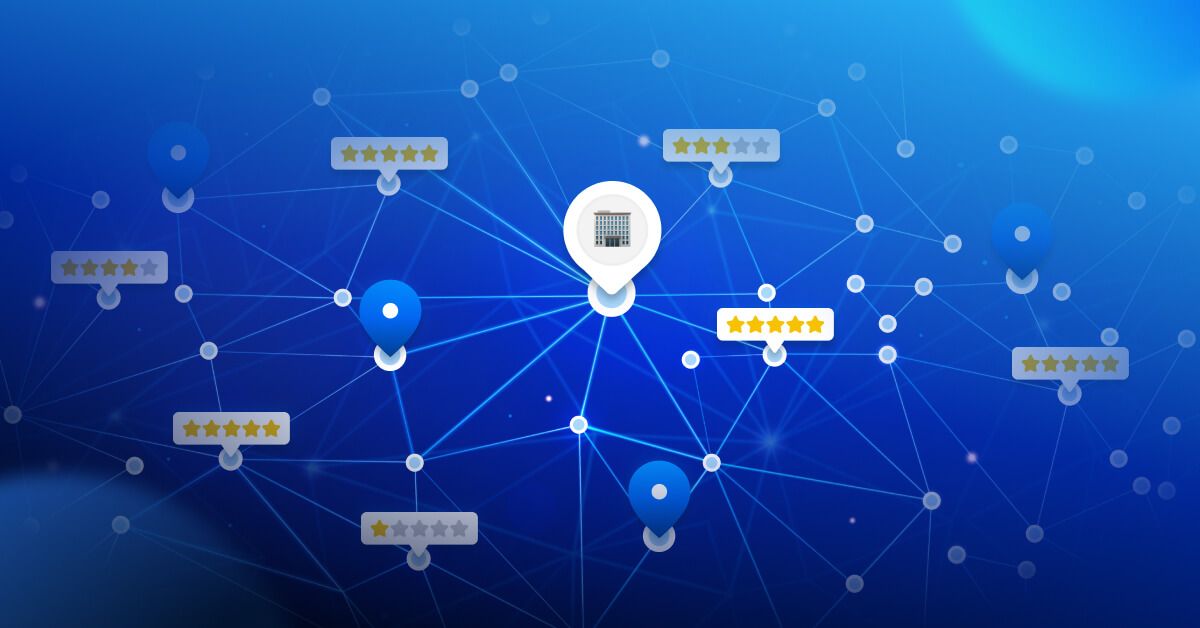
Every outlet generates reviews across several platforms at once: Google Maps, Facebook, TripAdvisor, local directories, and more. It’s not simple addition, it’s multiplication: the volume of reviews can quickly become unmanageable. A network of 300 outlets doesn’t manage 300 listings, but potentially more than a thousand, spread across interfaces that don’t talk to each other.
Without centralisation, it’s simply not possible to get the full picture. You can’t monitor an online reputation you can’t see.
Elevate your customer review management with Review Management +!
The second factor, more discreet, concerns the teams who manage these reviews.
Each outlet sometimes has its own way of managing reviews. Some managers respond systematically, others let it slide. The tone of voice set by head office isn’t always followed.
This inconsistency, less noticeable with ten outlets, becomes a real brand consistency problem once you’re dealing with a hundred or a thousand.
On top of these shared challenges, there’s a variable specific to each network: its own sector of activity.
A Geolid study, based on 227 French brands and nearly 700,000 Google reviews, shows that the monthly volume of reviews per outlet varies hugely from one sector to another:
| Sector | Reviews generated per month |
| Restaurants | 37 |
| Gyms | 16 |
| Hotels | 12 |
| Furniture | 12 |
| Leisure & culture | 7 |
| Car dealerships | 6 |
| Car services | 6 |
| Retail & supermarkets | 5 |
| Opticians & hearing aids | 4 |
| Cosmetics | 4 |
| Clothing | 4 |
| Beauty salons & hairdressers | 3 |
| Pharmacies | 2 |
| Real estate | 2 |
| Personal services | 2 |
| Insurance | 2 |
| Banks | 2 |
| Building & construction | 1 |
Two networks of the same size can therefore be facing completely different realities.
And the consequences go beyond team workload: the fewer reviews a sector generates, the more each one weighs in the final balance. A single negative review on a listing with only a handful of reviews has a proportionally much bigger impact than one lost among dozens published every month.
An outlet’s average rating stops being a reliable signal in a large network. An outlet whose online reputation dips gets statistically absorbed by the mass of the network: it doesn’t really move the overall score, and it doesn’t show up on any macro-level dashboard.
That doesn’t mean reviews lose their value.
It means the data that matters is no longer the score: it’s what customers actually write in their reviews.
A study by Harvard Business School and Boston University confirms this for New York restaurants: hygiene-related signals picked up in the text of Yelp reviews (mentions of pests, food handling issues, and so on) cause a significant drop in footfall. According to the study, more than half of that drop is explained by the wording of the comments, not the star rating. This is no mere coincidence.
The same principle applies to a network: it’s not an outlet’s average that needs monitoring, but what customers actually describe in their online reviews. A wait time mentioned a dozen times in the same outlet’s reviews says far more than a 0.2-star shift in the rating.
Want to turn your insights into action?
Request a custom demo now and learn how Competitive Intelligence can boost your network strategy.

One thing can’t be ignored: these local negative reviews, invisible in the aggregated data, still aren’t without consequences.
A BrightLocal study shows that 91% of consumers believe a brand’s local reviews influence their perception of the brand as a whole, and 89% say they directly influence their decision to visit.
So the problem nobody sees at macro level keeps silently eroding the overall brand image, review after review.
Governance is at the heart of the issue: who’s in control of responding to reviews?
Centralising everything at head office guarantees consistency of tone and brand, but standardisation comes at the cost of customer closeness, since nobody knows a dissatisfied customer better than the outlet manager who served them.
Leaving everything to local teams preserves that closeness, but exposes the network to the inconsistency already mentioned above: every outlet responds in its own way, whenever it wants, or doesn’t respond at all.
The answer is… that there isn’t one. No single model naturally wins out over this tension. Networks split between different approaches, depending on whether they want to prioritise consistency or customer closeness.
Review management is just one part of this balancing act, but it follows the same logic.
The hybrid approach is therefore the majority choice, but it’s far from being the unanimous norm. The right balance depends less on a universal formula and more on the size of the network, its sector, and the maturity of local teams.
What’s measured at one outlet has to be managed across a hundred. The real challenge isn’t choosing between centralising or handing things to local teams, but building a system that combines both approaches, without losing what makes each level strong.
That’s exactly the role of a platform built for networks like Partoo: giving head office the full picture, without taking away local teams’ control over their own reviews.
Talk about your project with a Partoo expert and get a tailor-made demo.
By Partoo
Transform the customer experience across your businesses with AI
Download the 2026 Barometer on online presence and e-reputation of businesses and gain practical insights to increase your chances of being cited by AI.
Since 18 September 2026, Google has been displaying Partoo’s Local Pack for many local searches…
Google updated the appearance of its search results page in Europe on 8 September 2026…

Choosing the right voice of customer platform can transform how you manage CX, provided you…
Receive our best articles and practical guides directly in your inbox every month