


 Help Center
 How to get help

September 16, 2026
Voice of Customer: the guide to listening and taking action with AI
Most businesses are already collecting Voice of the Customer data: Google reviews are piling up,…


Powered by Jim
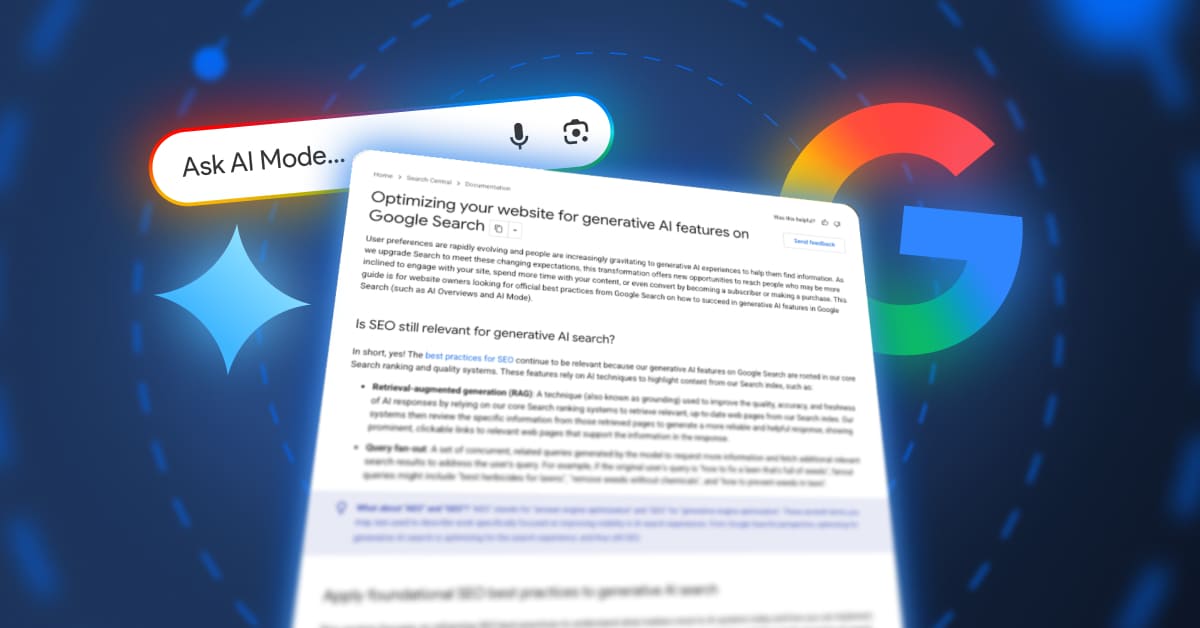
Table of contents
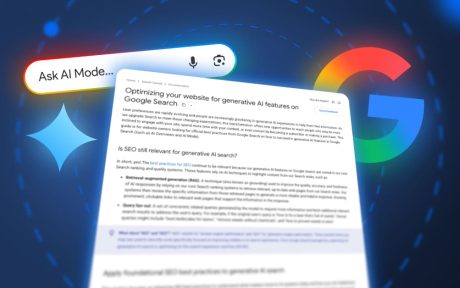
The documentation local businesses have been waiting for is here! On 15 May 2026, Google published its official guide to optimising your website and Google Business Profile (formerly Google My Business) to appear in AI Overviews and AI Mode.
Published via Google Search Central, this is the first time Google has brought together its official recommendations on content visibility within AI search results.
Partoo has summed up the key takeaways for you!
Google addresses head-on a question many have been asking since AI Overviews arrived: is SEO still relevant in the age of generative search?
The answer is clear-cut: yes, SEO remains the foundation of any optimisation strategy.
Google explains that its AI features continue to rely on its established Search systems — indexing, ranking, query understanding, and quality signals.
The guide highlights two key mechanisms that apply equally to traditional SEO and AI-generated responses:
RAG is a technique used to improve the quality, accuracy, and freshness of AI-generated responses. To do this, Google draws on its ‘classic’ ranking systems to retrieve relevant, up-to-date pages from its index. These pages are then analysed to generate a more reliable and useful response, complete with clickable links to the sources used.
This refers to a set of related queries simultaneously generated by the model to gather more information and surface relevant results for the user’s original request.
Google gives the following example: if the initial query is ‘how to treat a lawn overrun with weeds’, the secondary queries might include ‘best lawn herbicides’ or ‘removing weeds without chemicals’.
Just as with SEO, producing high-quality, original content is essential for strong GEO.
In its official recommendations, Google advises creating content that:
Google even draws a direct contrast between ‘commodity’ content — generic and easily replicated — and differentiated content that delivers real value.
In short: overly generic content will find it increasingly hard to stand out in AI-powered experiences.
Google also sets out several editorial best practices: structure pages clearly with readable headings and subheadings; write first and foremost for users (not to ‘please’ AI systems); and enrich content with quality images and videos. As Search becomes increasingly multimodal, visuals can now appear directly within AI responses.
On the technical side, Google reiterates several classic SEO recommendations.
To be eligible for AI features, a page must:
Google Business Profiles: the backbone of local GEO?
The guide also highlights the importance of local business data. AI responses can include product listings or recommend local businesses — drawing directly on the information provided in Google Business Profiles, among other sources.
For local businesses, this confirms a major trend: business listings are a key driver of visibility in AI search results.
The guide also highlights the importance of local business data. AI responses can include product listings or recommend local businesses — drawing directly on the information provided in Google Business Profiles, among other sources.
For local businesses, this confirms a major trend: business listings are a key driver of visibility in AI search results.
Fact or fiction? Google cuts through the noise by addressing the most common misconceptions about optimising for AI responses, one by one.
The guide explicitly states that the following are not necessary:
Google explains there is no need to create AI-specific files such as llms.txt. While Google may discover and index such files, they currently receive no special treatment in AI results — meaning their presence does not improve visibility in AI Overviews or AI Mode.
Some GEO strategies recommend breaking content into very small paragraphs to make it easier for AI models to process. Google counters this by stating that its systems are already capable of identifying relevant passages within longer pages covering multiple topics. There is no ‘ideal format’ designed specifically for AI.
The guide reminds us that Google’s systems already understand synonyms, context, and search intent. There’s no need to rewrite content in a ‘machine-friendly’ style (quite the opposite, in fact), or to create hyper-optimised pages for every possible variation of a query.
Producing large volumes of near-identical content purely to capture different query variations is a poor long-term strategy. Search systems are now capable of understanding the overall relevance of a piece of content, even without an exact match to the user’s query.
What about schema.org tags?
Although there are no schema.org structured data types specifically dedicated to AI, Google does reiterate how important structured data remains for any search visibility strategy, whether SEO or GEO.
Although there are no schema.org structured data types specifically dedicated to AI, Google does reiterate how important structured data remains for any search visibility strategy, whether SEO or GEO.
This guide clarifies one essential point: the era of generative search doesn’t spell the end of local SEO — it marks its evolution towards a far more qualitative and conversational logic.
For local businesses, the challenge is no longer simply ‘being visible’ on Google. It’s about becoming sources that are reliable, precise, and differentiated enough to be cited directly by Google’s AI.
In practice, this means that the quality of local information, the freshness of Google Business Profiles, data consistency, customer reviews, expert content, and photos will all play an increasingly strategic role in businesses’ online presence.
Search is gradually evolving from an engine that ranks links into an engine capable of recommending, comparing and summarising answers.
In this new paradigm, the local businesses that come out on top will be those that build a complete, credible, and constantly updated digital presence — for their users and for AI systems alike!

By Partoo
Download our free guide and discover how AI is reshaping local search, online reputation, and conversational commerce!
Most businesses are already collecting Voice of the Customer data: Google reviews are piling up,…

While Artificial Intelligence is revolutionising plenty of things, some elements remain unchanged. The traditional stages…

A satisfaction survey sent at the right moment gets a higher response rate and more…
Receive our best articles and practical guides directly in your inbox every month