


 Help Center
 How to get help
October 22, 2026
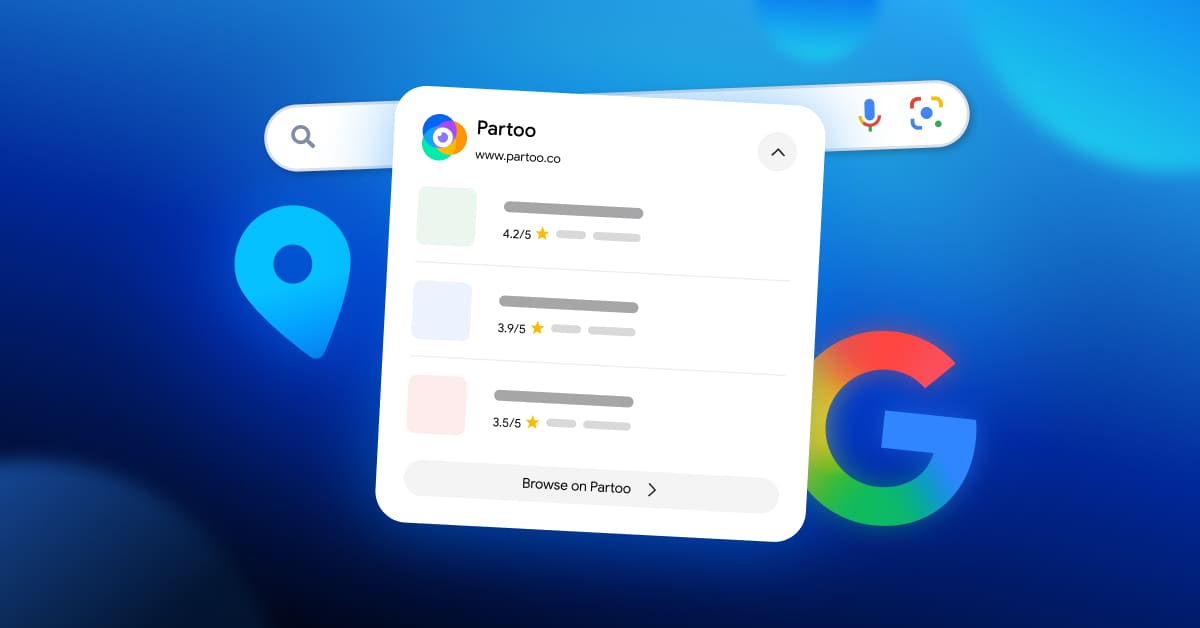
Partoo’s Local Pack now appears in Google search results
Since 18 September 2026, Google has been displaying Partoo’s Local Pack for many local searches…


Powered by Jim

 Written by Partoo
Table of contents
Every day, your customers are reaching out to you. They give you their opinions on various platforms, fill in your satisfaction surveys… You then collect these signals, but what happens next?
Most companies just let this feedback pile up in a dashboard. They hear their customers but then let things slide.
Companies that treat the voice of customer as a core strategy don’t just look at metrics: they follow a virtuous, continuous, and focused cycle, in which every signal received triggers an action. A loop that, with each turn, puts them ahead of the pack. Partoo explains how it works!
The “voice of the customer”, AKA VoC is often described as a marketing strategy with a beginning and an end. Conduct a survey, analyse the results, draw conclusions… And then things grind to a halt. Which is precisely why this linear approach stops initiatives in their tracks and prevents lasting impact!
Applying a virtuous cycle to the VoC is a fundamentally different approach. Each cycle provides insights that drive actions, creating new customer experiences and in turn new signals to collect. The more this loop turns, the more fine-tuned it gets. And each tweak along the way leads to faster, more precise decisions.
This marks the difference between a company that reacts to its customers and a company that continuously learns from them.
This model is based on five interdependent steps:
These steps don’t work in isolation; ignore one and you’ll break the cycle at your peril!
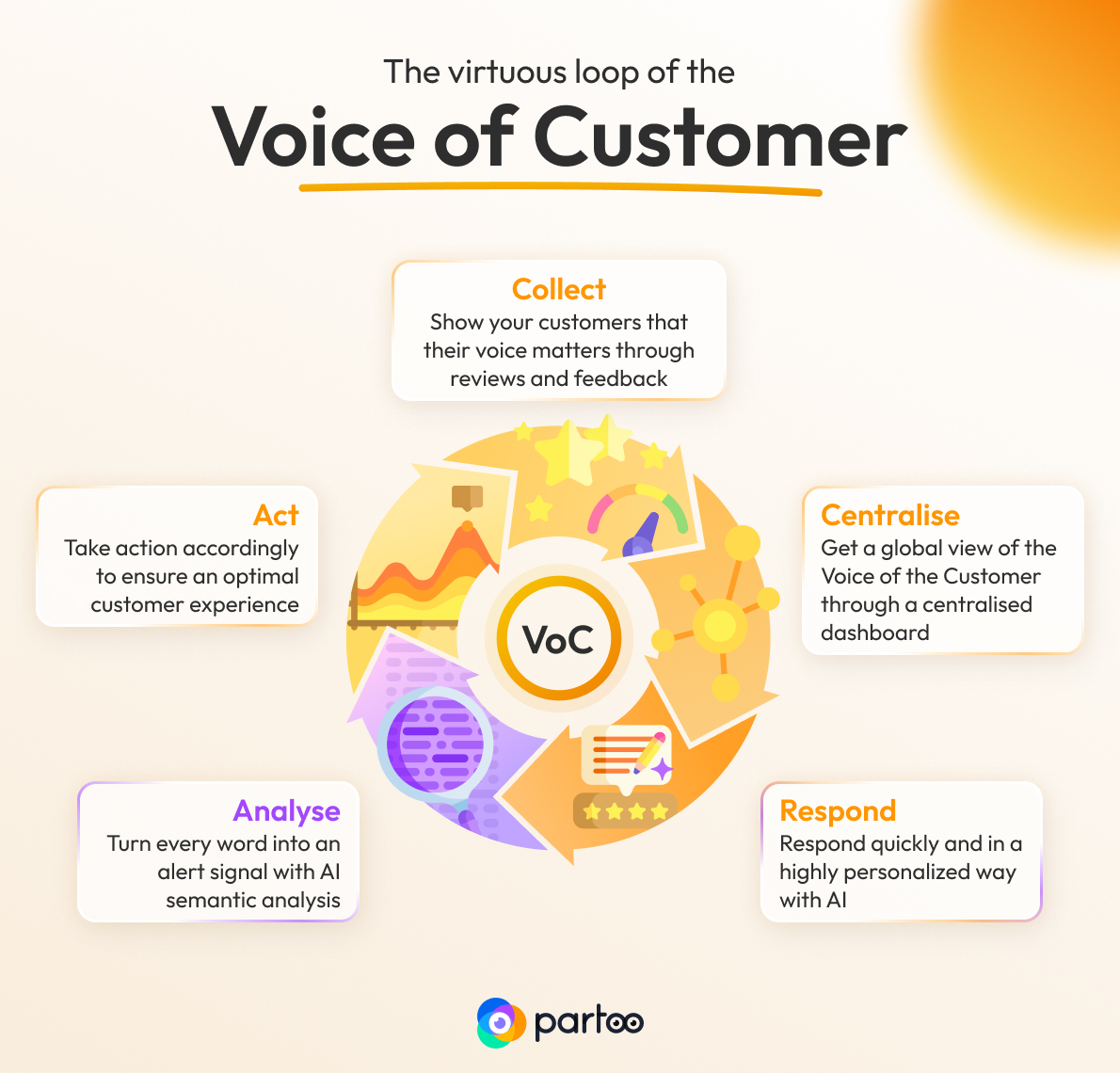
Diagram illustrating the voice of customer virtuous loop
A VoC loop isn’t built on the fly. It’s created step by step following a simple logic: each link strengthens the next one.
Feedback won’t always come to you. You must seek it out at the right time and on the right channel. Asking customers to leave a review, in-house satisfaction surveys… These are targeted sources, which is what makes them so valuable. And if you carefully structure the collection of this feedback, you’ll get a faithful view of what your customers really think.
But don’t get too carried away; collecting feedback doesn’t mean bombarding people! If you inundate a customer with requests, you could get on their nerves and miss out on a precious review.
Customer reviews, satisfaction surveys, and in-house feedback: the VoC is spread across multiple sources. If you don’t centralise feedback, it will be fragmented, hard to interpret, and impossible to manage.
So, the challenge in this step is to gather all signals under one roof and provide relevant teams access to this information. You can’t action something you can’t see!
Replying to a customer review or feedback, whether they’ve praised or slated you, is not a formality. It’s a strategic action. A customer who receives a speedy, personalised, and well-worded reply feels heard… and a customer who feels heard is likely to become a loyal one!
Plus, you won’t just improve the reviewer’s customer experience but also positively impact anyone who reads this exchange. The speed and quality of your reply will, therefore, improve (or destroy!) your e-reputation. This is where AI can play a pivotal role, helping your teams to respond faster at scale while using the right tone.
Manage your customer feedback in one click
Our Review Management tool centralises customer reviews and thanks to Jim, our AI agent, you can reply in a single click!
Our Review Management tool centralises customer reviews and thanks to Jim, our AI agent, you can reply in a single click!
Collecting feedback is a good first step. But understanding what it really means gives you an upper hand.
As the number of reviews increases, it can become impossible to manually process feedback and give it the attention it deserves.
This is where AI-powered qualitative analysis proves its worth by identifying recurring trends, detecting red flags before problems arise, organising insights by theme… It’s not about producing one more report; it’s about helping your teams to react quickly and make the right decisions.
Taking action is the pivotal step in this process. Without it, insights produced by the analysis are useless. The loop will just spin out of control without providing any tangible results.
Note, however, that action alone won’t cut it. It needs disciplined, structured, long-term follow-up. Every improvement initiative needs to be tracked by regularly verifying if the decisions taken are having a positive effect on the customer experience!
And it’s this very follow-up that showcases the” virtuous” nature of the VoC cycle. Each corrective action feeds back into the loop. An improved experience elicits better feedback, impacting the quality of the signals collected in the next cycle for exploitable data, leading to new decision-making and continuous improvement. The cycle, therefore, gets stronger with every turn.
This proactive, five-step feedback mechanism (collect – centralise – respond – analyse – act) ensures a high-performing “voice of customer” approach that goes beyond basic reporting.
Organisations that have fully embraced this strategy don’t just look at metrics: they follow a perpetual learning cycle, with each rotation increasing their lead over the competition!
By Partoo
Transform the customer experience across your businesses with AI
Download the 2026 Barometer on online presence and e-reputation of businesses and gain practical insights to increase your chances of being cited by AI.
Since 18 September 2026, Google has been displaying Partoo’s Local Pack for many local searches…
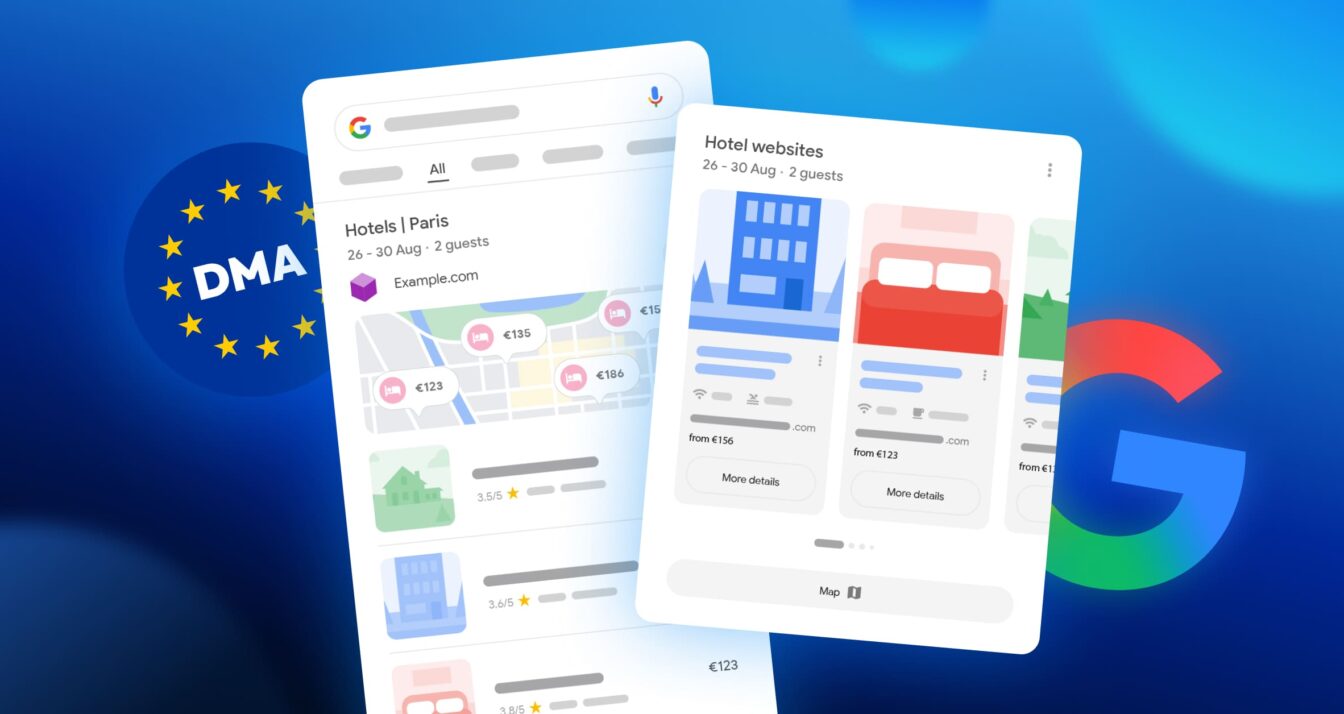
Google updated the appearance of its search results page in Europe on 8 September 2026…

Choosing the right voice of customer platform can transform how you manage CX, provided you…
Receive our best articles and practical guides directly in your inbox every month