


 Help Center
 How to get help
September 16, 2026
Voice of Customer: the guide to listening and taking action with AI
Most businesses are already collecting Voice of the Customer data: Google reviews are piling up,…


Powered by Jim

Table of contents
4.2/5 stars… Most companies would be delighted with this rating. For us, however, you could be moving into the danger zone!
We’ve all started jumping for joy when 4-star reviews appear on platforms. After all, it’s a fab rating, right? But don’t be fooled! In reality, a 4-star review is often the politest way for a customer to distance themselves.
It’s often a sign of a “lukewarm” experience: your customer didn’t have a major problem, but they’re not singing your praises either. As far as they’re concerned, you did the bare minimum.
And this is where the danger lies: these customers aren’t loyal; they’re just passing through. They’re just waiting for one thing: a competitor that will offer a slightly lower price or a slightly better experience to make them go elsewhere.
The difference is actually quite clear:
Not convinced? We’ll explain what’s really behind these 4-star reviews.
The red flag here isn’t the number of stars, but the adjectives used.
Compare your reviews with those of your competitors. If your customers write “Good service” or “Everything was fine”, while your competitor gets an “A must-visit establishment!” or “An amazing experience”, you’re losing your “emotional market share”.
And this is where a new, handy KPI comes into play: the Sentiment gap.
The “Sentiment gap” is the difference between functional satisfaction (the service was provided) and emotional attachment (the experience was memorable). It’s the subtle gap between a customer who gives 4 stars because “nothing was wrong” and one who gives 5 stars because “I recommend everything about this place.”
If your average rating is high but the Sentiment gap is widening — that is, the comments in your reviews are becoming shorter, neutral, and purely descriptive — your brand risks fading into the background.
And make no mistake about it: a lack of enthusiasm in your current reviews can quickly translate into a drop in your future sales. A “satisfied but not thrilled” customer isn’t a loyal customer. They’ll be more than sorely tempted by your competitor’s next bargain.
GenAI search habits (ChatGPT, Gemini, AI Mode) are continually evolving, and these new assistants are becoming the automatic go-to for many consumers. As a result, this gap in perception is turning into a major technical hurdle.
Why? Because generative search algorithms (LLM) no longer just look at average ratings but perform a deep semantic analysis of your customer reviews. To make recommendations, AI taps into the full semantic depth of your reviews when choosing who to recommend, so your customers’ words now matter more than ever.
If your Sentiment gap is too wide, AI-driven recommendation systems won’t even see you! Collecting more reviews, even if they’re 4 stars, won’t make a difference.
To better manage your online reputation, you need to classify your reviews into three categories. Each requires a different reaction.
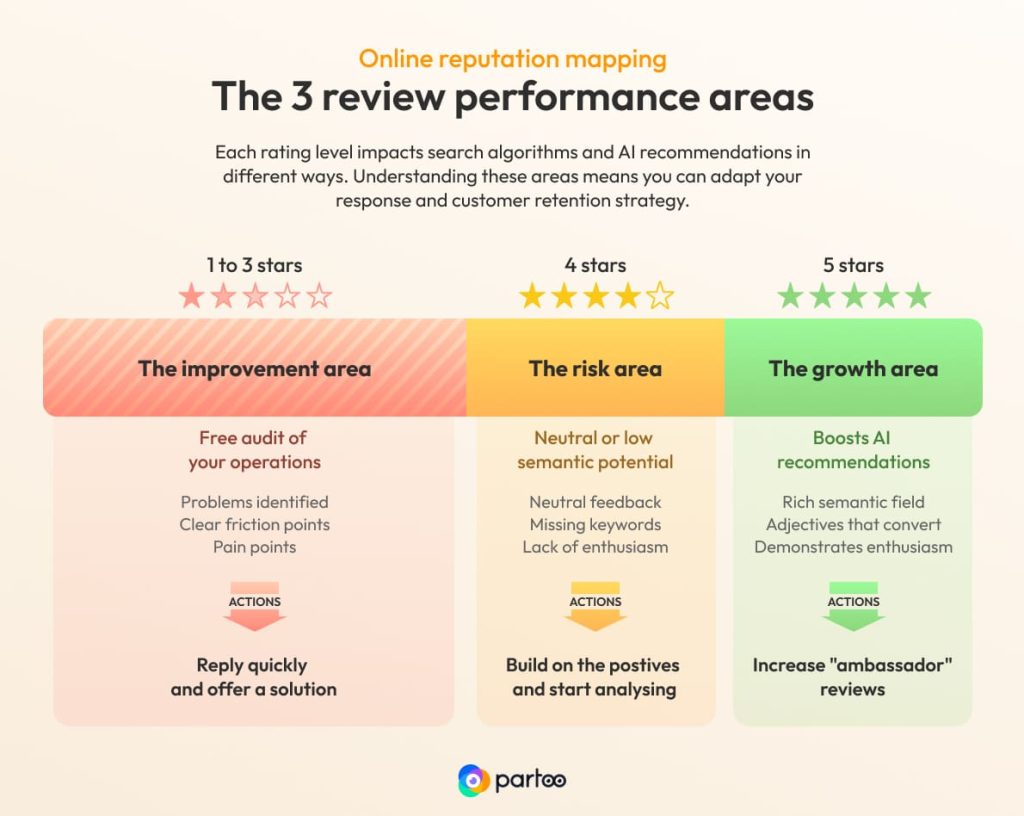
These customers are your best ambassadors. They’re not only satisfied but also advertise your content for free through their reviews. They provide the keywords and enthusiasm that search engines (and AI) need to recommend you to new prospects.
Your goal should be to multiply these reviews to drown out the competition.
This is the most deceptive area. The customer didn’t have a problem, but they also didn’t find anything special to say. The problem is that these opinions are often completely neutral and without emotion. They’re invisible because they lack precise details that AI needs to generate a recommendation.
A 4-star customer is an unreliable customer. They don’t have a particular attachment to your business and will go to a cheaper competitor or one with a new offer.
Your goal should be to get more than a simple, polite thank you:
For example, you could reply with, “Thanks so much for your 4 stars! We’d love to know what we can do to make it 5. If you come back to see us, please let us know, or feel free to give us a fresh review, as your feedback will really help us improve.”
The message here is clear: something’s not right. But ultimately, this is the easiest area to manage, as these reviews will top your to-do list. The problem is identified (waiting time, cleanliness, welcome), and you can immediately take action.
In some cases, these negative reviews present a real opportunity, as a publicly addressed or solved problem can often result in getting a loyal customer.
Your goal should be to respond quickly, in a measured way, and by proposing a solution.
AI doesn’t just read your ratings and reviews; it analyses how enthusiastic your customers are. You can perform a simple test to find out if you’re losing your “emotional market share”.
Ask ChatGPT or Gemini this specific question:
“What [type of business] in [city] do customers like the most and why?”
Then analyse the answer using this scorecard:
If your score’s low, you’re stuck in the risk area. Your customers are satisfied (your 4 stars prove so), but they’re not enthusiastic enough for AI to pick you from the bunch.
AI relies on the depth of reviews to recommend an establishment. If your customers don’t share their enthusiasm, the AI won’t even whisper your name.
Gone are the days when a 4/5 rating was enough to reassure customers. In an age when artificial intelligence is gradually becoming consumers’ guiding light, indifference is your worst enemy.
Nowadays, the real challenge is to be recommended, not just to get a good rating. This requires moving from passive review management to a focused semantic influence strategy, turning every satisfied customer into an enthusiastic ambassador.
Not sure where to start when it comes to engaging your customers or auditing your market?

We’ve listed the best prompts to help you start analysing your reputation and that of your competitors on AI search engines such as ChatGPT and Gemini.

By Partoo
Want to easily develop your business through the Internet? It’s possible thanks to Partoo!
Download the 2026 Barometer on online presence and e-reputation of businesses and gain practical insights to increase your chances of being cited by AI.
Most businesses are already collecting Voice of the Customer data: Google reviews are piling up,…
While Artificial Intelligence is revolutionising plenty of things, some elements remain unchanged. The traditional stages…

A satisfaction survey sent at the right moment gets a higher response rate and more…
Receive our best articles and practical guides directly in your inbox every month