


 Help Center
 How to get help

September 16, 2026
Voice of Customer: the guide to listening and taking action with AI
Most businesses are already collecting Voice of the Customer data: Google reviews are piling up,…


Powered by Jim
Table of contents
Back in the day, companies relied on gut instincts or forked out for costly annual reports from consulting firms when trying to figure out why customers were going elsewhere. The problem? By the time these analyses landed on your desk, consumer habits had already changed!
Your competitors reveal (almost) everything publicly: their customer reviews, their strengths, their weaknesses… and, above all, the reasons why customers choose them over you. All this information is out there, just a click away.
Reason enough to take 15 minutes to find out exactly why a customer is choosing one of your competitors over you! Ready? And we’re off!
The online presence battle isn’t a national one, but rather what’s going on “down the road”. The first pitfall is to only look at brands that are the same size as yours. Why? Because a well-optimised independent or little-known start-up competitor can capture all the local online traffic, meaning your outlet disappears into the ether despite your brand being well-known.
To define who your actual local competitors are, head over to Google Maps and follow these steps:
Got them? These are the outlets that are pinching your customers right now, regardless of how well-known they are across the nation.
Watch this video guide to get started and then repeat the steps on your own.
Now that you’ve identified your direct local competitors, it’s time to spot opportunities by analysing their Google Business listings.
Customers who aren’t happy with your competitors are your best future customers!
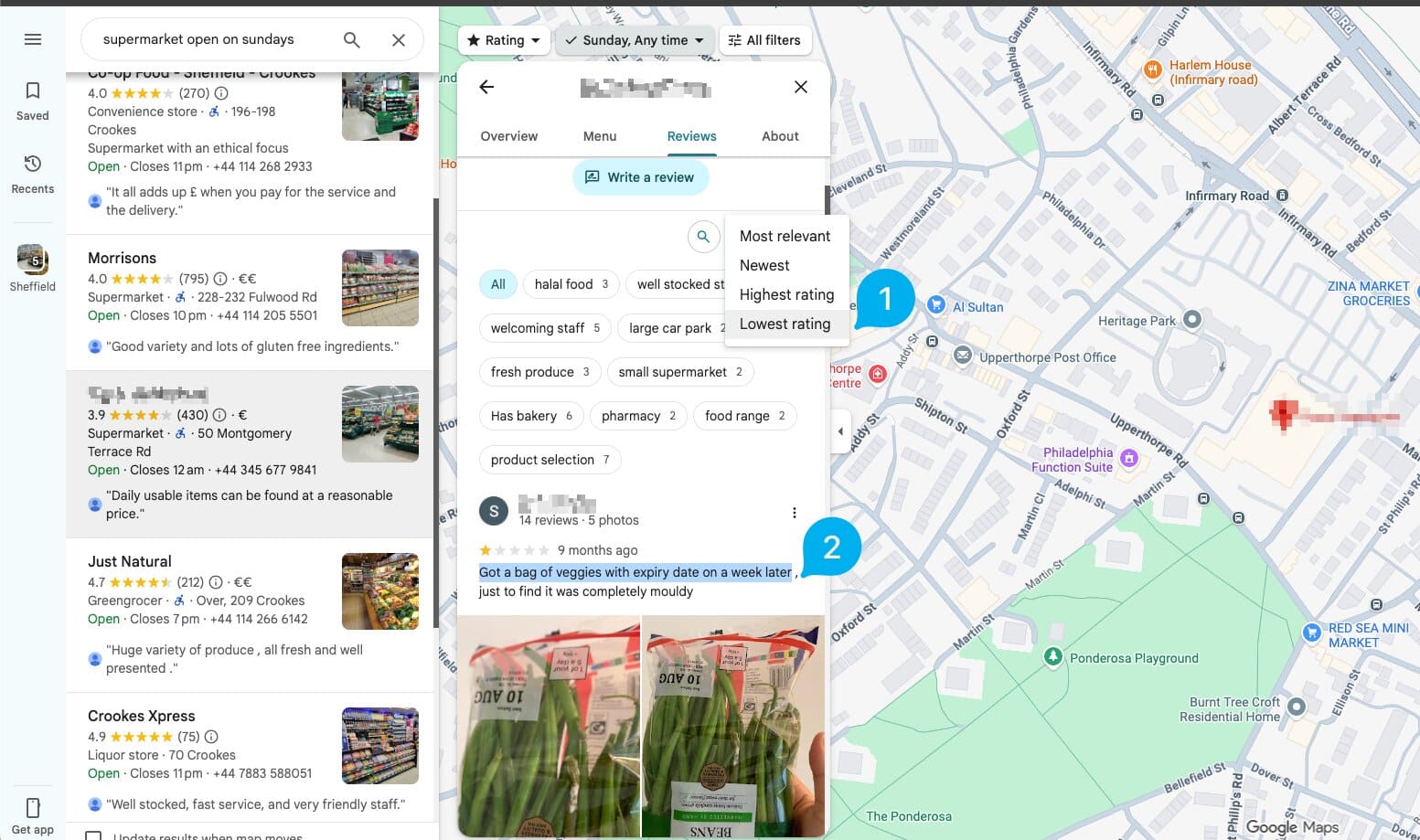
To figure out where the competition falls short, analyse their negative reviews. Take note of any pain points so you can see what sets you apart and how you can use them to boost your sales.
Turn your competitors’ shortcomings into your pulling power!
For example, if customers continually complain about a specific issue (endless queues at the till, poorly stocked fruit & veg aisle, etc.), this means you’ve got an opportunity staring you in the face. You won’t need to overhaul your outlets; just meet the customer needs that your competitors failed to supply.
The following steps will help you detect these opportunities:
Good to know
You can filter customer reviews by themes (price, quality, season, vegetables, etc.) on each Google listing. These themes are decided by AI based on customer reviews and can vary from one Google listing to another.
You can filter customer reviews by themes (price, quality, season, vegetables, etc.) on each Google listing. These themes are decided by AI based on customer reviews and can vary from one Google listing to another.
Once you’ve identified the pain points, you can use your competitors’ weaknesses to your advantage.
Continue your audit by studying your competitors’ positive reviews. Finding out what their customers love is a strategic way to raise your game.
It’s not about copying the competition but understanding their “signature strengths” so you can offer a better customer experience.
To use competitors’ customer reviews to see where they could pip you to the post:
You should also see if your competitors are replying to their reviews. A competitor who doesn’t reply or only responds to positive reviews leaves room for a brand that’s more attentive, human, and engaged.
By determining their strengths, you’ll be able to spot areas that require staff training to regain the upper hand.
A high rating is just a snapshot; it may bring a smile to your face, but it also signals a lack of momentum. Google’s algorithm and customers look for fresh feedback. A 4.8/5 rating may be reassuring, but it becomes misleading if the last reviews are from a few months ago.
Traditional and generative search engines use a constant stream of reviews as a sign of popularity. Note that Google gives a much higher trust score to reviews less than 3 months old.
Want to go further?
To get a comprehensive overview of your market, don’t just rely on one metric. A reliable competitive analysis draws on several key performance indicators (KPIs).
To get a comprehensive overview of your market, don’t just rely on one metric. A reliable competitive analysis draws on several key performance indicators (KPIs).
Step up a gear by comparing the number of reviews received in the last 30 days against your competitors. If your direct competitors get 10 reviews when you only receive one, you’ll gradually fade from Google’s and AI assistants’ top suggestions.
Well done, your audit is now complete! Now imagine applying this method to 50, 100, or 500 outlets.

While this 15-minute analysis is highly effective for a single store, scaling it across an entire network becomes humanly impossible. To manage your brand’s performance in real time, you need a tool that allows you to analyze the voice of the customer, compare it with your competitors, and transform it into a priority action plan—all across your entire store network, thanks to our Competitive Intelligence solution!

By Partoo
Transform the customer experience across your businesses with AI
Download the 2026 Barometer on online presence and e-reputation of businesses and gain practical insights to increase your chances of being cited by AI.
Most businesses are already collecting Voice of the Customer data: Google reviews are piling up,…

While Artificial Intelligence is revolutionising plenty of things, some elements remain unchanged. The traditional stages…

A satisfaction survey sent at the right moment gets a higher response rate and more…
Receive our best articles and practical guides directly in your inbox every month