


 Help Center
 How to get help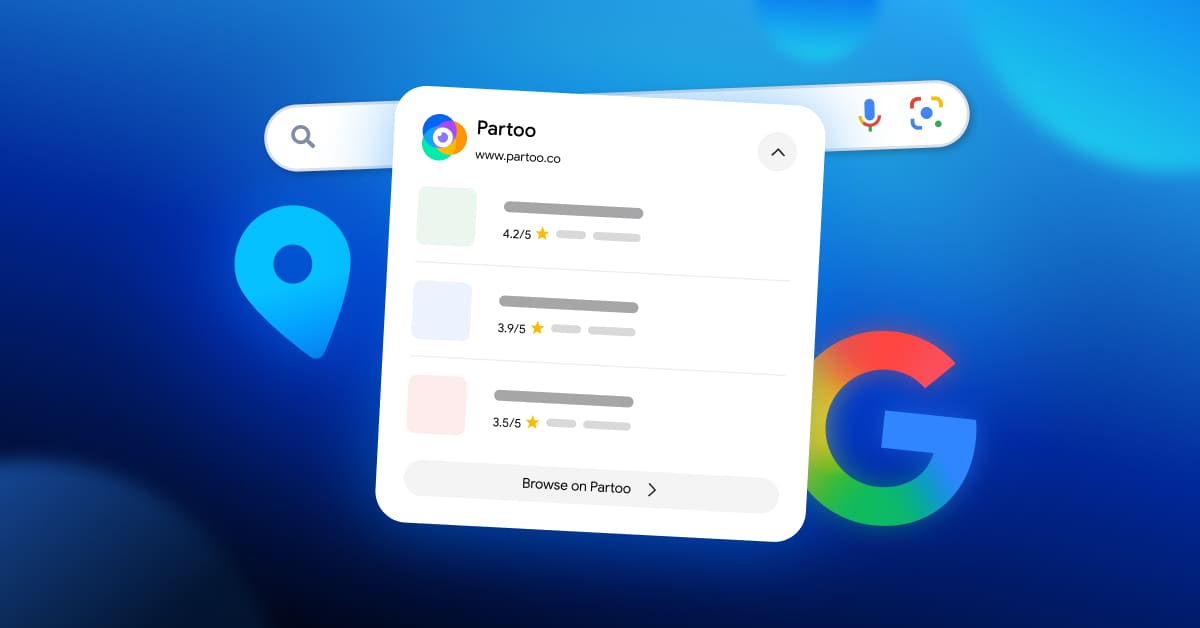
October 22, 2026
Partoo’s Local Pack now appears in Google search results
Since 18 September 2026, Google has been displaying Partoo’s Local Pack for many local searches…


Powered by Jim

Table of contents
A few years ago, just appearing on Google was enough. A well-optimised listing with sufficient reviews often ended up on the first page, and Google (which worked like a simple directory) would also display other results so users could pick and choose.
However, this approach no longer cuts it. Now, when a user searches for “the best accountant for a startup in London”, they don’t expect to work their way through a list of ten or so results. They ask an AI assistant a question and receive a personalized reply.
And that reply may be your competitor’s name. Partoo explains how it works!
This isn’t so much about a change in how results are visually displayed: it’s about a complete overhaul in the way AI ranks businesses.
For years, Google evaluated companies on mechanical criteria: proximity, keywords, number of reviews, average rating…
AI, on the other hand, doesn’t classify: it interprets. It crawls thousands of reviews and mentions to extract a synthesised reputation, which it then uses to answer your prospects’ questions.
| Aspects | Traditional Google search | An LLM (AI) query |
|---|---|---|
| What the user sees | A local pack and a list of links | A conversational recommendation |
| Main ranking criteria | Keywords (relevance) and proximity | Selection is largely based on the semantics (actual words) used by clients |
| How the user chooses | Chooses from a list of results | Trusts the AI-driven selection |
| Brand objectives | Topping the list | Be the only one recommended |
In traditional searches, coming in the top 4 was a good outcome. Conversational AI, however, only recommends one or two options, so you’ll be completely invisible if you rank any lower.

When choosing, AI won’t just look at average ratings, but what your customers have written about you. A 5-star rating without feedback doesn’t give these bots usable information. On the other hand, when a crawler repeatedly finds written feedback, such as “staff are incredibly patient with children”, it draws a reliable, trustworthy conclusion.
The content of the reviews, therefore, drives the recommendation: if your reviews lack content, AI won’t have anything to say about your brand… and will recommend a competitor with customer reviews that describe an actual experience. In short, if your competitors’ opinions are more descriptive than yours, AI has more material to highlight them.
Vague reviews equals invisible brand!

What are the 5 indicators that show your brand can be cited by AI? Download Partoo’s checklist to find out!
AI doesn’t start by taking a look at your website. It first looks at what customers have written about you on your Google profile, TripAdvisor, Facebook reviews… And it then uses this raw material to form an opinion about your brand.
In practical terms, it relies on four signals to structure its analysis:
AI identifies the words and phrases that crop up the most in your reviews to define your perceived strengths. If “speedy delivery” appears in 40% of your positive reviews, it will automatically associate your business with this quality, whether or not it’s one of your strategic priorities.
Words aside, AI assesses the overall tone: do your customers talk about you with enthusiasm, are they neutral or do they come across as annoyed? A brand with technically positive reviews but emotionally muted feedback will be ditched for a brand that elicits more genuine emotional engagement.
are particularly valuable in this respect. A specific comment, such as “they called our customer back on a Sunday evening to solve a critical problem”, carries a lot more weight than a dozen generic “very good service” mentions. AI immediately picks up on this type of specific comment and will reformulate it to appear in its recommendations.
plays a decisive role. Up-to-date reviews tell AI that your reputation is active and reflects the current experience. A bunch of three-year-old reviews, positive as they may be, carries less kudos when AI is deciding who to choose.
In concrete terms, if all your reviews boil down to variations of “good value for money” or “I recommend “, AI won’t find anything that sets you apart. It will choose a competitor whose customers have made the effort to describe a real experience that allows it to generate a trustworthy, personalized recommendation.
The easiest way to see how AI perceives you is to directly ask it. Open your favorite LLM and ask:
“Give me 3 reasons why a customer should choose [Competitor Name] over [Your Brand Name] in [City].”
The answer you’ll get isn’t an opinion: it’s an accurate reflection of what AI has learned from your customers and those of your competitors. If the LLM says your competitor is “more responsive” or “more suitable for large companies”, it’s because that perception is rooted in the data it analysed. You’re seeing exactly how AI presents your brand to prospective customers, often for the very first time.
To objectively measure your perception gap, use the following scoring grid:
| If AI… | Penalty |
|---|---|
| Cites a service that you offer but doesn’t believe you do. | +5 points |
| Rates your competitor as “more reliable” or “better rated”. | +3 points |
| Tells a specific positive story about your competitor. | +3 points |
| Struggles to find a reason to choose you. | +5 points |
| Mentions that you have “less recent reviews”. | +2 Points |
| Total Score | /18 |
The higher your score, the bigger the perception gap, and it means you need to act swiftly!
A high score doesn’t mean that your offer is worse than your competitor’s: it means that AI doesn’t have the necessary elements to choose you. This point is critical because it implies that the problem isn’t your product or service; it’s the “material” that your customers have left for AI to pick up and then use.

By Partoo
Download the 2026 Barometer on online presence and e-reputation of businesses and gain practical insights to increase your chances of being cited by AI.
Since 18 September 2026, Google has been displaying Partoo’s Local Pack for many local searches…
Google updated the appearance of its search results page in Europe on 8 September 2026…

Choosing the right voice of customer platform can transform how you manage CX, provided you…
Receive our best articles and practical guides directly in your inbox every month