



 Help Center
 How to get help
September 16, 2026
Voice of Customer: the guide to listening and taking action with AI
Most businesses are already collecting Voice of the Customer data: Google reviews are piling up,…


Powered by Jim

Table of contents
In 2025, studies showed that almost 30%* of Black Friday sales were influenced by AI and 34%* of consumers say they’re happy to buy using an AI agent. With our almost daily use of artificial intelligence, web searches are undergoing huge changes. AI agents are among the current major shifts in the purchasing journey, thanks to tech that can research, compare, and even purchase products online on behalf of users.
What is agentic commerce, and how can you position yourself in this emerging e-tail landscape? This article covers all you need to know.
Evolving search behaviours are driving new online user experience formats. Agentic commerce is one of these developments and could well become a key step in the future of e-tail.
Agentic commerce refers to a form of online shopping where AI agents act on behalf of users: they analyse a need, scour the web, compare available offers, and suggest (or even make) the most relevant purchase.
Up to now, users have navigated websites themselves. Now, thanks to LLMs, they can delegate these actions to an AI agent. Web users no longer browse sites directly; instead, they consume content through a single AI interface.
What is an AI agent?
Un agent IA est un logiciel autonome capable d’agir à la place d’un utilisateur pour accomplir des tâches précises. Contrairement à un chatbot traditionnel, limité à la réponse conversationnelle, un agent IA exécute des actions concrètes.
Un agent IA est un logiciel autonome capable d’agir à la place d’un utilisateur pour accomplir des tâches précises. Contrairement à un chatbot traditionnel, limité à la réponse conversationnelle, un agent IA exécute des actions concrètes.
For example, a user might ask, “What pair of shoes do you recommend for running a marathon?” The AI agent will then analyse the query, browse different websites, compare the best performing models, and suggest a suitable selection. This single interface means the user can access a list of recommendations with links and make a purchase without having to search online.
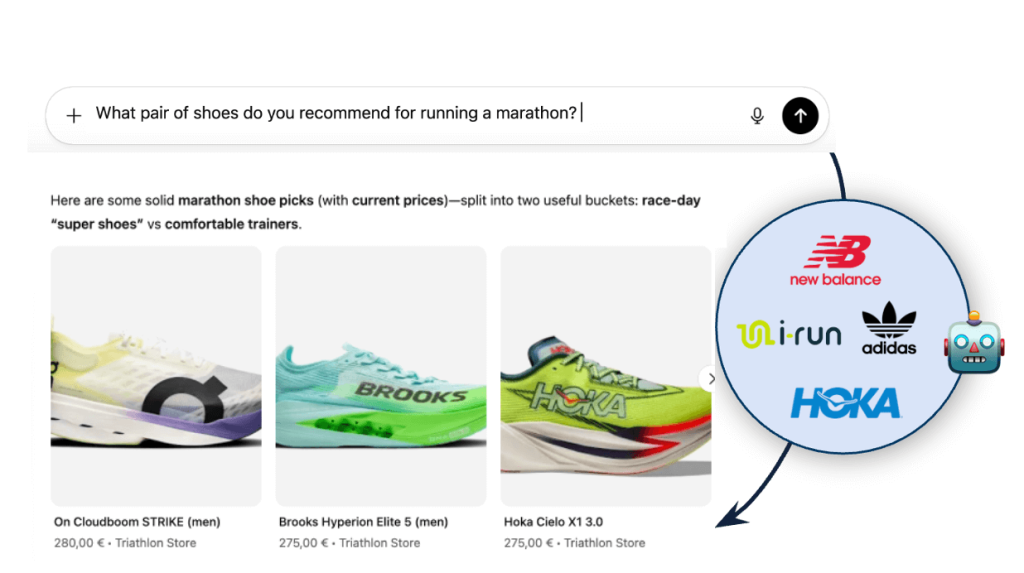
Today, there are three main ways AI agents act on behalf of users during the purchasing journey.
On-site agents (integrated into a website)
An on-site agent is an assistant integrated into a website that acts as a real-time sales advisor. It helps guide the user during their purchase, answers complex questions, and personalises product recommendations. Amazon, for example, launched Rufus, an AI agent designed to facilitate and personalise the shopping experience on its platform.
At Partoo, we’ve developed Jim, an AI agent that can be integrated into any website, capable of automatically replying to Internet users while simplifying qualified lead generation.
Jim, your new AI assistant
Jim automates repetitive tasks such as replying to messages and reviews, collects leads, analyses your customers’ feedback, and optimises your company’s online presence across all platforms – including in AI responses!

Operators (stand-alone web browsers)
Some AI agents go even further by taking direct control of the web browser. They can browse, add products to a basket, and make a purchase for the user, without the latter lifting a finger.
OpenAI introduced this approach with the launch of ChatGPT Atlas, its in-house web browser. Amazon also offers a similar feature with Buy for Me, which allows an agent to purchase a product for a user that’s not on the e-tailer’s platform.
Agent protocols (direct integration with payment)
An agent protocol is an AI agent with a specific technical integration that allows the purchase to be completed directly from its interface, i.e. without redirection to a third-party site. This requires a secure connection between the AI, the merchant site, and a payment system. The first agent protocols were created on ChatGPT with the new Instant Checkout feature (currently only available in the US and for a few e-tail sites).
Agentic commerce is therefore redefining how consumers search for, compare and purchase products and services. Watch our webinar to find out more :
The arrival of agentic reservations
In addition to buying products, AI agents are beginning to manage service bookings for users. This development is specifically geared towards sectors such as restaurants, hotels, and automobiles. For example, TheFork recently launched a feature on ChatGPT, allowing users to book a table directly from the interface, without leaving the conversation.
In addition to buying products, AI agents are beginning to manage service bookings for users. This development is specifically geared towards sectors such as restaurants, hotels, and automobiles. For example, TheFork recently launched a feature on ChatGPT, allowing users to book a table directly from the interface, without leaving the conversation.
With the arrival of agentic commerce, AI is set to consult websites more than humans. It’s therefore essential that you provide clear, complete, and usable information tailored to these algorithms.
AI agents don’t care about website design, the user experience (UX), or the visual hierarchy of a site. They rely on structured data, tags, metadata, and textual content.
This means you should think of your website as an AI-friendly exploitable database. Here are the three main pillars to optimise that will help you convince AI.
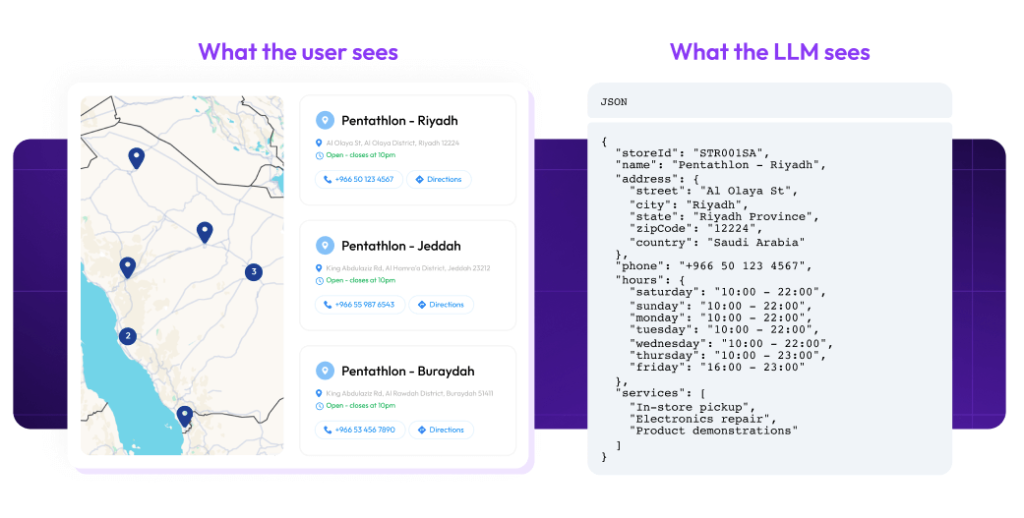
Structured data plays a vital role in a site’s ability to appear in the results displayed by agentic commerce. Think of it as “invisible tags” that ensure AI crawlers reliably interpret every element of a website.
When an LLM generates a local response, it will rely on this data. If the data isn’t structured, AI won’t be able to interpret it, and it may just disappear into the ether. In 60-70% of cases, this structured data (like schema.org tags) comes from the pages of a store locator. A real goldmine for AI, a store locator is an interactive map where a brand’s outlets are listed/displayed, allowing Internet users to locate the nearest establishment.
AI crawls for accurate information such as:
The more structured, complete, and up to date the data is, the more likely you are to appear in complex contextual responses generated by AI agents.
Developing your online presence means you’ll be able to multiply the sources of information available to AI agents. Unlike Internet users, agents never rely on a single channel; they systematically cross-reference data from various sources.
Being present on different media such as official sites, directories, comparison sites, local platforms, etc., will boost your credibility in the eyes of AI.
The more an AI agent finds a brand or establishment in several places on the web, the more likely it is to trust the business and list it high up in search results. On the other hand, just appearing on one channel creates uncertainty and reduces visibility.
Social proof is a fundamental local SEO pillar. While internet users won’t necessarily read all reviews, AI agents can analyse all feedback in a flash.
AI scans UGC (User Generated Content), which is content provided by users that’s perceived as neutral and authentic feedback. AI will therefore analyse:
By cross-referencing sources, it aims to ensure the objectivity of the data provided and accurately assess user perception. It compares brands, ranks outlets, and decides which ones to recommend. Customer reviews, therefore, directly shape the image that AI has of your brand. It will also factor in negative signals. Lots of bad reviews or a lack of replies to reviews may be enough to prevent an establishment from being recommended.
The ushering in of agentic commerce marks the shift from AI “that helps” to AI “that decides”, transforming the web into a vast database where visibility no longer depends on snazzy websites, but on the clarity of the information provided to algorithms.
Transform the customer experience across your businesses with AI
Download our free guide and discover how AI is reshaping local search, online reputation, and conversational commerce!
Most businesses are already collecting Voice of the Customer data: Google reviews are piling up,…

While Artificial Intelligence is revolutionising plenty of things, some elements remain unchanged. The traditional stages…

A satisfaction survey sent at the right moment gets a higher response rate and more…
Receive our best articles and practical guides directly in your inbox every month