


 Help Center
 How to get help
October 22, 2026
Partoo’s Local Pack now appears in Google search results
Since 18 September 2026, Google has been displaying Partoo’s Local Pack for many local searches…


Powered by Jim
 Written by Partoo
Table of contents
While Artificial Intelligence is revolutionising plenty of things, some elements remain unchanged. The traditional stages of the customer journey are one of them. You know them well: discovery, consideration, purchase, loyalty and, finally, recommendation.
What’s changing now is how your customers’ satisfaction shows up throughout this journey, as well as the opportunities that arise to capture what they’re saying about you.
In this article, we’ll help you understand where the Voice of Customer plays out at each stage of the customer journey, the key moments you can’t afford to miss, and the friction points that could cost you customers!
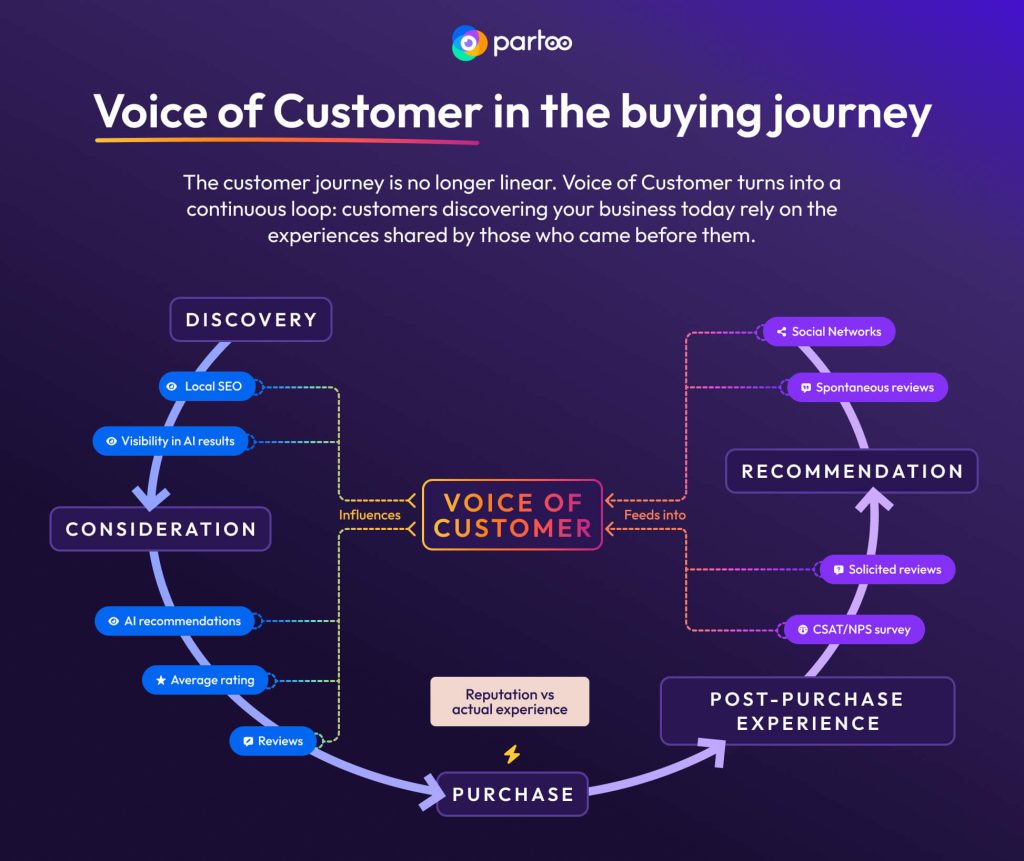
At every one of these stages, signals pass between the customer and the business, reflecting their level of satisfaction, whether expressed or simply perceived. That’s what we call the Voice of Customer — the full range of signals, explicit or not, through which a customer lets you know what they think of their experience.
This voice doesn’t travel in one direction only. Sometimes the customer receives it, when they read what others have said before them. Sometimes they express it themselves, becoming a source of information for someone else in turn.
Rather than a straight line that stops at recommendation, what actually takes shape is a genuine loop: the customer discovering you today is relying on the voice of a customer who came before them. And the customer who stays loyal to you today will become, tomorrow, the voice that brings in a new one.
| Journey stage | What it involves | Where the Voice of Customer shows up |
|---|---|---|
| Discovery | The customer identifies a need and searches, usually online, for a business, product or service that could meet it. | Reviews that feed into local SEO and visibility in AI results |
| Consideration | The customer compares several options before choosing the one that best matches what they’re looking for, based on personal criteria. | Reviews compared across businesses, average rating, AI recommendations based on reviews |
| Purchase | The customer takes action. For a local business, that means booking an appointment, making a reservation, visiting the outlet, or requesting a quote. | The gap between the actual experience and what the reviews or Google listing led them to expect |
| Loyalty (or post-purchase experience) | The customer uses the product or service over time, assesses their experience, and contacts customer service if needed. This is the moment that determines whether they’ll come back. | Solicited reviews, response to a satisfaction survey (NPS/CSAT) |
| Recommendation | The customer shares their experience with others, good or bad, particularly through online reviews. | Spontaneous reviews posted online, word of mouth (digital or otherwise), social media posts |
But not all touchpoints in the journey carry the same weight: some matter far more than others in shaping the customer’s final perception. These are the moments of truth.
In the 1980s, Jan Carlzon, then CEO of the airline Scandinavian Airlines (SAS), popularised the idea that every interaction between a customer and a business, however brief, is a decisive moment that shapes the customer’s perception of the brand.
Once that perception turns negative, it can be hard to win back: according to PwC’s Experience is Everything study, 32% of consumers say they’d abandon a brand they love after just one bad experience.
In 2011, nearly thirty years later, Google built on the concept and introduced ZMOT (Zero Moment of Truth). This is the moment when the customer looks for information even before the first direct contact with the business — typically, reading reviews or searching online before visiting or calling. It covers both discovery and consideration, up until any direct contact takes place.
The concept spread quickly and gave rise to several variations:
CX leaders clearly understand what’s at stake in these moments of truth: 85% say a single unresolved issue is enough to lose a customer, even right from the very first contact, according to Zendesk’s CX Trends 2026 report.
How AI is shaking up the “Zero Moment of Truth”
In a classic Google search, the customer opts for several listings and their reviews, in order to choose. With conversational AI built into search engines (AI Mode, AI Overviews), it’s AI that now takes the lead. Rather than search results to sort through and compare, AI now serves up recommendations directly, sometimes featuring a smaller number of businesses. Customer reviews are, in fact, among the main sources used by LLMs. AI is therefore steadily establishing itself as a new interface between your future customers and your past ones. An evolution in local search you really can’t afford to ignore
In a classic Google search, the customer opts for several listings and their reviews, in order to choose. With conversational AI built into search engines (AI Mode, AI Overviews), it’s AI that now takes the lead. Rather than search results to sort through and compare, AI now serves up recommendations directly, sometimes featuring a smaller number of businesses. Customer reviews are, in fact, among the main sources used by LLMs. AI is therefore steadily establishing itself as a new interface between your future customers and your past ones. An evolution in local search you really can’t afford to ignore
At every stage of the customer journey, moments of truth are tipping points that can swing the experience in a positive or negative direction. When the tip is negative, it feeds into a review, a response to a satisfaction survey, or both at once.
These friction points aren’t vague, generic problems you have no control over. Quite the opposite: each one corresponds to a precise moment in the customer experience that went wrong, and one that can be identified.
Friction points can take many forms, and crop up at any stage of the journey:
All of the friction points above share one thing in common: something happens, and it goes badly. An interaction does take place, but it turns into discomfort or disappointment — with the risk of it turning up in your reviews and surveys.
There’s another category of friction, of a different nature altogether: it’s not the interaction that fails, it’s the very opportunity to make contact with the customer that never happens at all. The customer doesn’t come forward, the business has no idea, and no signal — no review, no complaint — ever reveals it. These missed opportunities are all the harder to spot because, by definition, they leave no trace:
Spotting a friction point once it’s already driven a customer away is too late. Yet, your customer feedback contains several indicators that let you catch it beforehand, even if they can go unnoticed when looked at individually:
A gradual decline in the share of positive reviews: you can spot this by comparing the share of 4-5 star reviews on a rolling basis (month by month), rather than focusing on your listings’ average rating. This is an indicator that’s easy to miss if you focus solely on the average rating, which is built on several hundred reviews and only shifts very slowly…
A gradual increase in the time it takes to respond to reviews or customer messages. This is a signal that’s often invisible internally because it worsens little by little, but it reveals a double problem: a slower response time isn’t just an issue of service quality as perceived by the customer, it’s also often a sign that an internal organisation is starting to fall behind.
The same keyword or negative theme coming up again and again across different reviews. It’s not a single negative opinion that should catch your attention, but the repetition of the same word or the same idea. How do you spot this across a whole network? Through thematic analysis or automatic tagging of reviews, rather than reading every single review by hand — something that’s simply not sustainable once you’re past a dozen outlets.
Elevate your customer review management with Review Management +!
A growing gap between the average review rating and the score from internal satisfaction surveys (NPS/CSAT) over the same period. If the two move in different directions, or increasingly diverge, it’s a sign that one of the two channels is picking up on something the other isn’t. A more granular comparison of performance, along with semantic analysis of customer feedback, can then help identify what’s driving that gap.
Negative reviews piling up at one specific outlet, while the network average stays stable. This is a particularly important signal for any multi-outlet network. A network-wide average can easily mask a problem that’s heavily concentrated in two or three outlets, invisible unless you drill down to the level of each individual outlet.
Once you’ve identified the friction points and analysed the signals, one question remains: where do you start? Not every area for improvement deserves the same level of oversight, and not all of them can be kicked off by the head office alone.
Some friction points are one-off, specific to a single outlet, and are best handled locally: it’s the local team — the one that knows its customers and deals with them every day — that’s best placed to fix it quickly.
Others, however, are systemic: they crop up again and again across different outlets and point to an underlying problem in a process shared across the whole network. The Voice of Customer tools give the head office the right visibility to identify and address these network-wide issues.
This is where real collaboration between the two levels needs to happen:
That said, these efforts need to be sustained over time if you genuinely want to improve perception — and therefore satisfaction — among your customers.
For a network, there’s a real risk in failing to sustain this improvement loop that the Voice of Customer makes possible. The more outlets you have, the more easily local realities can slip past you. A static read of the customer journey leaves you to lose touch on what your customers are really saying and the difficulties your teams are facing.
So don’t treat this as a one-off audit, done once a year. The Voice of Customer — reviews and feedback combined — is precisely the mechanism that keeps that picture continuously up to date, at both central and local level.
Want to see how AI can change the way you understand what your customers are telling you? Download our practical guide to the Voice of Customer.
Voice of Customer: move from measurement to action

By Partoo
Transform the customer experience across your businesses with AI
Download the 2026 Barometer on online presence and e-reputation of businesses and gain practical insights to increase your chances of being cited by AI.
Since 18 September 2026, Google has been displaying Partoo’s Local Pack for many local searches…
Google updated the appearance of its search results page in Europe on 8 September 2026…
Choosing the right voice of customer platform can transform how you manage CX, provided you…
Receive our best articles and practical guides directly in your inbox every month